SOLDES
Jusqu'à -70% sur une sélection d'articles*

Nouveauté
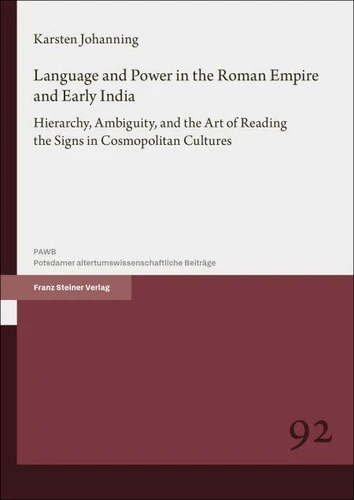
Language and Power in the Roman Empire and Early India. Hierarchy, Ambiguity, and the Art of Reading the Signs in Cosmopolitan Cultures
Par :Formats :
Disponible dans votre compte client Decitre ou Furet du Nord dès validation de votre commande. Le format PDF est :
- Compatible avec une lecture sur My Vivlio (smartphone, tablette, ordinateur)
- Compatible avec une lecture sur liseuses Vivlio
- Pour les liseuses autres que Vivlio, vous devez utiliser le logiciel Adobe Digital Edition. Non compatible avec la lecture sur les liseuses Kindle, Remarkable et Sony
 , qui est-ce ?
Notre partenaire de plateforme de lecture numérique où vous retrouverez l'ensemble de vos ebooks gratuitement
Pour en savoir plus sur nos ebooks, consultez notre aide en ligne ici
C'est si simple ! Lisez votre ebook avec l'app Vivlio sur votre tablette, mobile ou ordinateur :

- Nombre de pages257
- FormatPDF
- ISBN978-3-515-14163-5
- EAN9783515141635
- Date de parution08/07/2026
- Protection num.Digital Watermarking
- Taille3 Mo
- Infos supplémentairespdf
- ÉditeurFranz Steiner
Résumé
Attempting to bypass earlier and present discussions about Romanization, identity, and globalization, this e-book confronts the issue of cultural elite integration in the early Roman Empire in a new way by focussing on prestige language as a connecting factor in a Eurasian context. Thus, through a comparison with a central period in early Indian history (around 300 BC-AD 600), Karsten Johanning seeks to add perspectives from Sanskrit to the Greco-Roman cosmopolitanism of both emperors and intellectuals.
Four case studies are structured around different types of signs: on the body, in fictitious literature, in religious discourse, and in topography.
Drawing on these, Johanning shows that for cosmopolitans in Rome and India, the ability to read and interpret signs in different contexts was essential for creating both cosmopolitan life-worlds, distinction, and social boundaries. Ancient cosmopolitans, well versed in different intertextual systems, were therefore able to make the most out of the complex hierarchies and inherent ambiguities of the premodern world.
Yet the social stakes were always high, especially at the competitive and volatile imperial courts of universal rulers.
Drawing on these, Johanning shows that for cosmopolitans in Rome and India, the ability to read and interpret signs in different contexts was essential for creating both cosmopolitan life-worlds, distinction, and social boundaries. Ancient cosmopolitans, well versed in different intertextual systems, were therefore able to make the most out of the complex hierarchies and inherent ambiguities of the premodern world.
Yet the social stakes were always high, especially at the competitive and volatile imperial courts of universal rulers.