
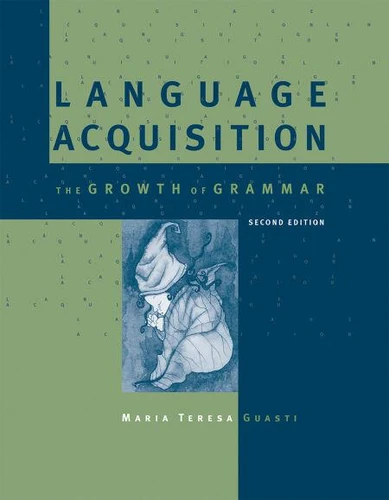
Language Acquisition, second edition. The Growth of Grammar
Par :Formats :
Disponible dans votre compte client Decitre ou Furet du Nord dès validation de votre commande. Le format ePub protégé est :
- Compatible avec une lecture sur My Vivlio (smartphone, tablette, ordinateur)
- Compatible avec une lecture sur liseuses Vivlio
- Pour les liseuses autres que Vivlio, vous devez utiliser le logiciel Adobe Digital Edition. Non compatible avec la lecture sur les liseuses Kindle, Remarkable et Sony
- Non compatible avec un achat hors France métropolitaine
 , qui est-ce ?
Notre partenaire de plateforme de lecture numérique où vous retrouverez l'ensemble de vos ebooks gratuitement
Pour en savoir plus sur nos ebooks, consultez notre aide en ligne ici
C'est si simple ! Lisez votre ebook avec l'app Vivlio sur votre tablette, mobile ou ordinateur :

- Nombre de pages672
- FormatePub
- ISBN978-0-262-34227-8
- EAN9780262342278
- Date de parution10/02/2017
- Protection num.Adobe DRM
- Taille4 Mo
- Infos supplémentairesepub
- ÉditeurBradford Books
Résumé
The new edition of a comprehensive introduction to a rapidly developing field, combining developmental data with theory. How do children begin to use language? How does knowledge of language emerge in early infancy, and how does it grow? This textbook offers a comprehensive introduction to knowledge acquisition, drawing on empirical evidence and linguistic theory. The theoretical framework used is the generative theory of Universal Grammar; students should have some familiarity with concepts in linguistic research.
Aimed at upper-level undergraduate and graduate students, the book offers end-of-chapter summaries, key words, study questions, and exercises. This second edition has been thoroughly updated, with new content throughout. It has been reorganized according to the three main components of language acquisition. The computational components and the interfaces are covered in chapters on structure building in the verbal and nominal domains, movement-derived structure, and the relation between syntax and semantics and semantic and pragmatic.
The sensory motor interface is treated in chapters on infants' perception of language and on the acquisition of words. The intentional-conceptual interface is discussed in chapters on the acquisition of words. This edition features additional cross-linguistic content, a new focus on brain imaging findings and the motor aspect of language, new material on Williams and Down Syndromes and dyslexia, and a new chapter on bilingualism, early second language acquisition, and bimodalism.
Revisions reflect the burgeoning research in the field. New pedagogical features include chapter outlines, summaries of chapters, hypotheses, and linguistic milestones; methodological information; explanatory boxes; and suggestions for further reading.
Aimed at upper-level undergraduate and graduate students, the book offers end-of-chapter summaries, key words, study questions, and exercises. This second edition has been thoroughly updated, with new content throughout. It has been reorganized according to the three main components of language acquisition. The computational components and the interfaces are covered in chapters on structure building in the verbal and nominal domains, movement-derived structure, and the relation between syntax and semantics and semantic and pragmatic.
The sensory motor interface is treated in chapters on infants' perception of language and on the acquisition of words. The intentional-conceptual interface is discussed in chapters on the acquisition of words. This edition features additional cross-linguistic content, a new focus on brain imaging findings and the motor aspect of language, new material on Williams and Down Syndromes and dyslexia, and a new chapter on bilingualism, early second language acquisition, and bimodalism.
Revisions reflect the burgeoning research in the field. New pedagogical features include chapter outlines, summaries of chapters, hypotheses, and linguistic milestones; methodological information; explanatory boxes; and suggestions for further reading.