
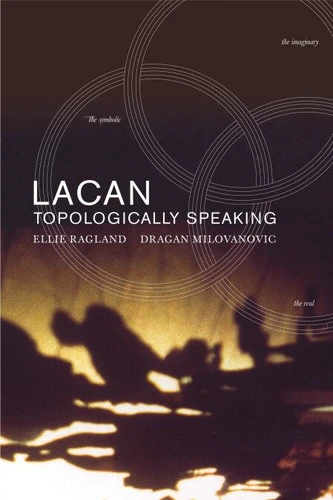
Lacan: Topologically Speaking
Par :Formats :
Disponible dans votre compte client Decitre ou Furet du Nord dès validation de votre commande. Le format ePub protégé est :
- Compatible avec une lecture sur My Vivlio (smartphone, tablette, ordinateur)
- Compatible avec une lecture sur liseuses Vivlio
- Pour les liseuses autres que Vivlio, vous devez utiliser le logiciel Adobe Digital Edition. Non compatible avec la lecture sur les liseuses Kindle, Remarkable et Sony
- Non compatible avec un achat hors France métropolitaine
 , qui est-ce ?
Notre partenaire de plateforme de lecture numérique où vous retrouverez l'ensemble de vos ebooks gratuitement
Pour en savoir plus sur nos ebooks, consultez notre aide en ligne ici
C'est si simple ! Lisez votre ebook avec l'app Vivlio sur votre tablette, mobile ou ordinateur :

- Nombre de pages440
- FormatePub
- ISBN978-1-63542-110-1
- EAN9781635421101
- Date de parution08/09/2020
- Protection num.Adobe DRM
- Taille9 Mo
- Infos supplémentairesepub
- ÉditeurOther Press Professional
Résumé
The study of topology examines the way something can change shape while still retaining the same properties. Jacques Lacan devoted the last part of his teaching to the topology of the subject. During the 50s, he gauged the topology of surfaces (torus, Moebius strips, Klein bottles, crosscaps) and from 1972 on, he studied the topology of knots (Borromean, the sinthome). Showing that bodily and mental life function topologically, he did what no one had done before: he added to the logic of how representations function, the logic of jouissance or libidinal meaning that "materializes" language by making desire, fantasy, and the partial drives ascertainable functions of it.
For Lacan, topology is neither myth nor metaphor. It is the precise way we may understand the construction and appearance of the subject. Space is multidimensional in terms of both meaning and logic. Lacanian topology answers questions of post-structuralism while revealing the flaws in its theories. It also advances a 21st-century teaching that obviates symbolic logic and its positivistic assumptions.
Applications are made to the clinic, to literature, and to the social sciences. The authors collected here include world renowned Lacanian topologists such as Jacques-Alain Miller, Jeanne Lafont, Jean-Paul Gilson, Pierre Skriabine, Juan-David Nasio, Jean-Michel Vappereau, and several new theorists from the United States and Europe.
For Lacan, topology is neither myth nor metaphor. It is the precise way we may understand the construction and appearance of the subject. Space is multidimensional in terms of both meaning and logic. Lacanian topology answers questions of post-structuralism while revealing the flaws in its theories. It also advances a 21st-century teaching that obviates symbolic logic and its positivistic assumptions.
Applications are made to the clinic, to literature, and to the social sciences. The authors collected here include world renowned Lacanian topologists such as Jacques-Alain Miller, Jeanne Lafont, Jean-Paul Gilson, Pierre Skriabine, Juan-David Nasio, Jean-Michel Vappereau, and several new theorists from the United States and Europe.