
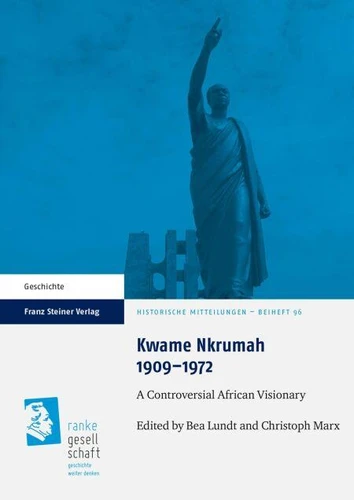
Kwame Nkrumah 1909–1972. A Controversial African Visionary
Par : ,Formats :
Disponible dans votre compte client Decitre ou Furet du Nord dès validation de votre commande. Le format PDF est :
- Compatible avec une lecture sur My Vivlio (smartphone, tablette, ordinateur)
- Compatible avec une lecture sur liseuses Vivlio
- Pour les liseuses autres que Vivlio, vous devez utiliser le logiciel Adobe Digital Edition. Non compatible avec la lecture sur les liseuses Kindle, Remarkable et Sony
 , qui est-ce ?
Notre partenaire de plateforme de lecture numérique où vous retrouverez l'ensemble de vos ebooks gratuitement
Pour en savoir plus sur nos ebooks, consultez notre aide en ligne ici
C'est si simple ! Lisez votre ebook avec l'app Vivlio sur votre tablette, mobile ou ordinateur :

- Nombre de pages208
- FormatPDF
- ISBN978-3-515-11575-9
- EAN9783515115759
- Date de parution28/10/2016
- Protection num.Digital Watermarking
- Taille5 Mo
- Infos supplémentairespdf
- ÉditeurFranz Steiner
Résumé
In 1957, Ghana was the first sub-Saharan country in Africa to achieve independence. The key African figure in this process was Kwame Nkrumah, the first president of the new state. Having studied in the USA and in London he was influenced by socialist and pan-African ideals. His ambitious projects in the fields of education and scientific as well as technological development provided an example for other former colonies.
But in 1966 he was overthrown by a military coup supported by the USA and died in exile in 1972. Fifty years later, his memory is omnipresent in Ghanaian society and in other African countries. Still, his achievements are a subject of controversy. Was he a hero of the anti-colonial struggle or an authoritarian dictator? This volume presents chapters by researchers from Ghana, Austria, Germany, and the USA.
They analyse the visionary politics of Nkrumah, investigate the reasons for the growing protest against his rule and shed new light on the background of the coup. The last part is dedicated to questions of evaluation and memory. Fifty years after his fall from power, new research and distance from the events allow for a more balanced judgment of Nkrumah.
But in 1966 he was overthrown by a military coup supported by the USA and died in exile in 1972. Fifty years later, his memory is omnipresent in Ghanaian society and in other African countries. Still, his achievements are a subject of controversy. Was he a hero of the anti-colonial struggle or an authoritarian dictator? This volume presents chapters by researchers from Ghana, Austria, Germany, and the USA.
They analyse the visionary politics of Nkrumah, investigate the reasons for the growing protest against his rule and shed new light on the background of the coup. The last part is dedicated to questions of evaluation and memory. Fifty years after his fall from power, new research and distance from the events allow for a more balanced judgment of Nkrumah.