
Martin Pfeiffer studied and taught Indology at the Freie Universität Berlin.
He published Elements of Kurux Historical Phonology (1972) and Indische
Mythen vom Werden der Welt: Texte, Strukturen, Geschichte (1994), and he
translated some 50 non-fiction books into German (mostly from English, but
also from Italian, French, Russian, and Serbo-Croatian, while it was still a
language).
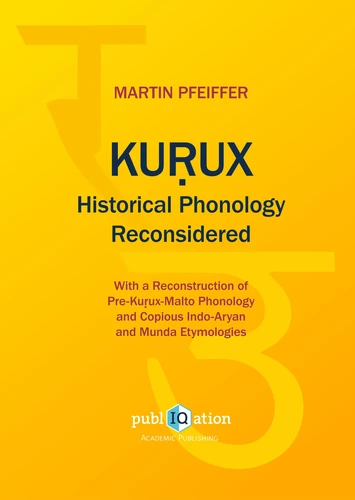
Kurux Historical Phonology Reconsidered. With a Reconstruction of Pre-Kurux-Malto Phonology
Par :Formats :
Disponible dans votre compte client Decitre ou Furet du Nord dès validation de votre commande. Le format PDF est :
- Compatible avec une lecture sur My Vivlio (smartphone, tablette, ordinateur)
- Compatible avec une lecture sur liseuses Vivlio
- Pour les liseuses autres que Vivlio, vous devez utiliser le logiciel Adobe Digital Edition. Non compatible avec la lecture sur les liseuses Kindle, Remarkable et Sony
 , qui est-ce ?
Notre partenaire de plateforme de lecture numérique où vous retrouverez l'ensemble de vos ebooks gratuitement
Pour en savoir plus sur nos ebooks, consultez notre aide en ligne ici
C'est si simple ! Lisez votre ebook avec l'app Vivlio sur votre tablette, mobile ou ordinateur :

- Nombre de pages480
- FormatPDF
- ISBN978-3-7458-6987-3
- EAN9783745869873
- Date de parution03/08/2018
- Protection num.Digital Watermarking
- Taille3 Mo
- Infos supplémentairespdf
- ÉditeurPubliQation
Résumé
Kurux (Oraon), with Malto and Brahui a member of the North Dravidian subfamily of the Dravidian languages, is spoken primarily in the Indian state of Jharkhand. The objective of the present study is to investigate the evolution of the Kurux phonemic system. This evolution can be described as a sequence of the Proto-Dravidian stage, the processes of sound change that
followed upon this stage, the Pre-Kurux-Malto stage, and the further processes of sound change which led to modern Kurux.
Both stages and both sets of processes of sound change are reconstructed in detail, proceeding from the Kurux etyma included in the revised edition of the Dravidian Etymological Dictionary (1984), from which selections had to be made, however: Items of non-Dravidian (Indo-Aryan, Munda, Persian) origin as well as doubtful cases had to be identified and left out of account, so that the Proto-Dravidian reconstructions presented here are based on only 43 per cent of the Kurux etyma registered in the revised edition of the Dravidian Etymological Dictionary.
Additional subjects dealt with include identification of the comparative evidence available for Proto-North-Dravidian, discussion of features that can serve as isoglosses for the North Dravidian subfamily, and considerations regarding the original home of the speakers of North Dravidian languages.
Both stages and both sets of processes of sound change are reconstructed in detail, proceeding from the Kurux etyma included in the revised edition of the Dravidian Etymological Dictionary (1984), from which selections had to be made, however: Items of non-Dravidian (Indo-Aryan, Munda, Persian) origin as well as doubtful cases had to be identified and left out of account, so that the Proto-Dravidian reconstructions presented here are based on only 43 per cent of the Kurux etyma registered in the revised edition of the Dravidian Etymological Dictionary.
Additional subjects dealt with include identification of the comparative evidence available for Proto-North-Dravidian, discussion of features that can serve as isoglosses for the North Dravidian subfamily, and considerations regarding the original home of the speakers of North Dravidian languages.
A propos de Martin Pfeiffer
10,99 €
16,95 €