


Nouveauté
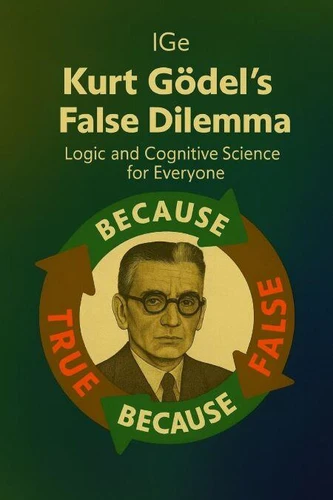
Kurt Gödel's False Dilemma
Par :Formats :
Disponible dans votre compte client Decitre ou Furet du Nord dès validation de votre commande. Le format ePub est :
- Compatible avec une lecture sur My Vivlio (smartphone, tablette, ordinateur)
- Compatible avec une lecture sur liseuses Vivlio
- Pour les liseuses autres que Vivlio, vous devez utiliser le logiciel Adobe Digital Edition. Non compatible avec la lecture sur les liseuses Kindle, Remarkable et Sony
, qui est-ce ?Notre partenaire de plateforme de lecture numérique où vous retrouverez l'ensemble de vos ebooks gratuitement
Pour en savoir plus sur nos ebooks, consultez notre aide en ligne ici
- FormatePub
- ISBN8232203542
- EAN9798232203542
- Date de parution26/11/2025
- Protection num.pas de protection
- Infos supplémentairesepub
- ÉditeurDraft2Digital
Résumé
Kurt Gödel (1906-1978) was an Austrian-born American mathematician, logician, and philosopher of science, born in Brünn (today Brno, Czech Republic). I write here about his most famous work, known to almost everyone: the first incompleteness theorem. I demonstrate that, from the perspective of science and practical logic, it has never truly reached a proven state. Because of the lighthearted style of my exposition, it may seem unusual that my analysis contains some humorous elements-yet the essential argument remains solid.
Some readers may even take offense at the idea that a nearly 100-year-old scientific theorem, which in reality functioned more as a dogma, has now collapsed-or, more accurately, been exposed. What makes this even more striking is the simplicity of the matter: understanding it requires only about half an hour of reading, and the core idea, illustrated through my "twenty questions" teaching example, takes just a few minutes.
According to my tests, even 14- to 15-year-old students can grasp it.
Some readers may even take offense at the idea that a nearly 100-year-old scientific theorem, which in reality functioned more as a dogma, has now collapsed-or, more accurately, been exposed. What makes this even more striking is the simplicity of the matter: understanding it requires only about half an hour of reading, and the core idea, illustrated through my "twenty questions" teaching example, takes just a few minutes.
According to my tests, even 14- to 15-year-old students can grasp it.
Kurt Gödel (1906-1978) was an Austrian-born American mathematician, logician, and philosopher of science, born in Brünn (today Brno, Czech Republic). I write here about his most famous work, known to almost everyone: the first incompleteness theorem. I demonstrate that, from the perspective of science and practical logic, it has never truly reached a proven state. Because of the lighthearted style of my exposition, it may seem unusual that my analysis contains some humorous elements-yet the essential argument remains solid.
Some readers may even take offense at the idea that a nearly 100-year-old scientific theorem, which in reality functioned more as a dogma, has now collapsed-or, more accurately, been exposed. What makes this even more striking is the simplicity of the matter: understanding it requires only about half an hour of reading, and the core idea, illustrated through my "twenty questions" teaching example, takes just a few minutes.
According to my tests, even 14- to 15-year-old students can grasp it.
Some readers may even take offense at the idea that a nearly 100-year-old scientific theorem, which in reality functioned more as a dogma, has now collapsed-or, more accurately, been exposed. What makes this even more striking is the simplicity of the matter: understanding it requires only about half an hour of reading, and the core idea, illustrated through my "twenty questions" teaching example, takes just a few minutes.
According to my tests, even 14- to 15-year-old students can grasp it.