
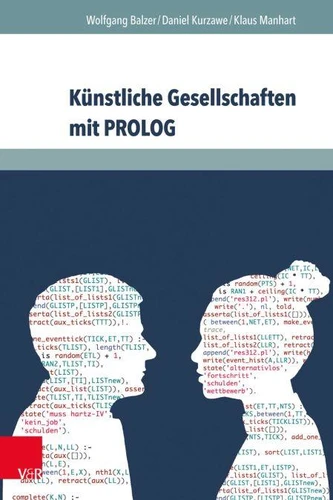
Künstliche Gesellschaften mit PROLOG. Grundlagen sozialer Simulation
Par : , ,Formats :
Disponible dans votre compte client Decitre ou Furet du Nord dès validation de votre commande. Le format PDF est :
- Compatible avec une lecture sur My Vivlio (smartphone, tablette, ordinateur)
- Compatible avec une lecture sur liseuses Vivlio
- Pour les liseuses autres que Vivlio, vous devez utiliser le logiciel Adobe Digital Edition. Non compatible avec la lecture sur les liseuses Kindle, Remarkable et Sony
 , qui est-ce ?
Notre partenaire de plateforme de lecture numérique où vous retrouverez l'ensemble de vos ebooks gratuitement
Pour en savoir plus sur nos ebooks, consultez notre aide en ligne ici
C'est si simple ! Lisez votre ebook avec l'app Vivlio sur votre tablette, mobile ou ordinateur :

- Nombre de pages278
- FormatPDF
- ISBN978-3-8470-0332-8
- EAN9783847003328
- Date de parution22/10/2014
- Protection num.pas de protection
- Taille2 Mo
- Infos supplémentairespdf
- ÉditeurV&R Unipress
Résumé
Dieses Buch bietet einen Einstieg in das interdisziplinäre Thema der sozialen Simulation mit PROLOG. Die Autoren wenden sich vor allem an Studierende der Geistes- und Sozialwissenschaften sowie an Interessenten, die keine oder wenig Erfahrung mit Computersimulationen im sozialen Bereich haben. Vermittelt wird zum einen formales Basiswissen über Simulation und Modellierung. Zum anderen wird mit der einfach handhabbaren Programmiersprache PROLOG konkret gezeigt, wie man Akteure, Gruppen und Gesellschaften sowie damit zusammenhängende soziale Phänomene formalisiert und in ein ablauffähiges Computerprogramm bringt.
This book provides an introduction to the interdisciplinary subject of social simulation with PROLOG.
It primarily addresses students of humanities and social sciences as well as interested people who have no or very little experience with computer simulations in the social sphere. It offers not only a formal basic knowledge of simulation and modelling, but also demonstrates, using the straightforward PROLOG programming language, how actors, groups and societies and related social phenomena can be formalised and compiled into an executable computer programme.
It primarily addresses students of humanities and social sciences as well as interested people who have no or very little experience with computer simulations in the social sphere. It offers not only a formal basic knowledge of simulation and modelling, but also demonstrates, using the straightforward PROLOG programming language, how actors, groups and societies and related social phenomena can be formalised and compiled into an executable computer programme.