SOLDES
Jusqu'à -70% sur une sélection d'articles*

Kinetic Craniums: The Shock-Absorbing Biomechanics of the Woodpecker. Hyoid Bones, Deceleration, and the Microscopic Evolutionary Safeguards Against Avian Concussions
Par :Formats :
Disponible dans votre compte client Decitre ou Furet du Nord dès validation de votre commande. Le format ePub est :
- Compatible avec une lecture sur My Vivlio (smartphone, tablette, ordinateur)
- Compatible avec une lecture sur liseuses Vivlio
- Pour les liseuses autres que Vivlio, vous devez utiliser le logiciel Adobe Digital Edition. Non compatible avec la lecture sur les liseuses Kindle, Remarkable et Sony
 , qui est-ce ?
Notre partenaire de plateforme de lecture numérique où vous retrouverez l'ensemble de vos ebooks gratuitement
Pour en savoir plus sur nos ebooks, consultez notre aide en ligne ici
C'est si simple ! Lisez votre ebook avec l'app Vivlio sur votre tablette, mobile ou ordinateur :

- Nombre de pages197
- FormatePub
- ISBN978-3-565-42102-2
- EAN9783565421022
- Date de parution20/04/2026
- Protection num.pas de protection
- Taille817 Ko
- Infos supplémentairesepub
- ÉditeurEmphaloz Publishing House
Résumé
If a human intentionally repeatedly slammed their face into a solid oak tree at fifteen miles per hour, the resulting brain damage would be instantly fatal. Yet, a woodpecker performs this exact violent deceleration up to twenty times a second, enduring 1, 200 Gs of force without suffering a single concussion. How does their brain survive this impossible kinetic trauma?
The answer lies in one of the most bizarre and brilliant shock-absorbing systems in evolutionary biology: the hyoid bone.
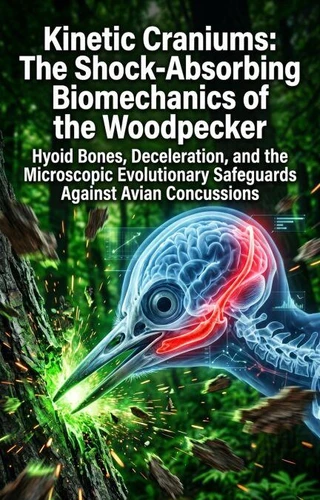
Unlike human anatomy, the woodpecker's extremely long, elastic tongue bone does not terminate in the throat. Instead, it splits and wraps entirely around the back of the skull, anchoring between the eyes. Upon impact, this bone acts like a biological seatbelt, instantly tightening and evenly distributing the massive shockwaves away from the fragile brain tissue. This captivating biological exploration uncovers the physical mechanics of avian survival.
It examines the microscopic structure of their spongy cranial bones, the protective inner eyelid that prevents their eyes from popping out, and how aerospace engineers are currently copying this exact anatomy to design better black boxes for airplanes. Discover the ultimate biological shock absorber. Analyzing the woodpecker's cranium reveals the extraordinary evolutionary engineering required to withstand extreme, repetitive deceleration.
Unlike human anatomy, the woodpecker's extremely long, elastic tongue bone does not terminate in the throat. Instead, it splits and wraps entirely around the back of the skull, anchoring between the eyes. Upon impact, this bone acts like a biological seatbelt, instantly tightening and evenly distributing the massive shockwaves away from the fragile brain tissue. This captivating biological exploration uncovers the physical mechanics of avian survival.
It examines the microscopic structure of their spongy cranial bones, the protective inner eyelid that prevents their eyes from popping out, and how aerospace engineers are currently copying this exact anatomy to design better black boxes for airplanes. Discover the ultimate biological shock absorber. Analyzing the woodpecker's cranium reveals the extraordinary evolutionary engineering required to withstand extreme, repetitive deceleration.