SOLDES
Jusqu'à -70% sur une sélection d'articles*

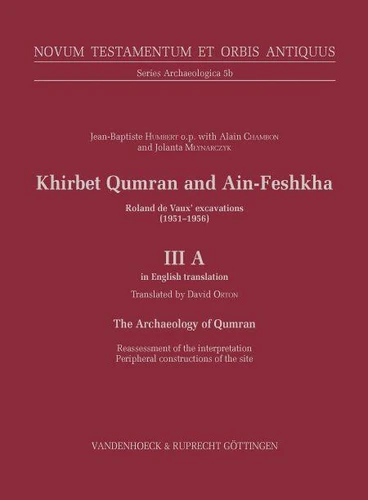
Khirbet Qumran and Ain-Feshkha III A (in English translation). Roland de Vaux' excavations (1951–1956). The Archaeology of Qumran. Reassessment of the interpretation Peripheral constructions of the site
Par : , , ,Formats :
Disponible dans votre compte client Decitre ou Furet du Nord dès validation de votre commande. Le format PDF est :
- Compatible avec une lecture sur My Vivlio (smartphone, tablette, ordinateur)
- Compatible avec une lecture sur liseuses Vivlio
- Pour les liseuses autres que Vivlio, vous devez utiliser le logiciel Adobe Digital Edition. Non compatible avec la lecture sur les liseuses Kindle, Remarkable et Sony
 , qui est-ce ?
Notre partenaire de plateforme de lecture numérique où vous retrouverez l'ensemble de vos ebooks gratuitement
Pour en savoir plus sur nos ebooks, consultez notre aide en ligne ici
C'est si simple ! Lisez votre ebook avec l'app Vivlio sur votre tablette, mobile ou ordinateur :

- Nombre de pages542
- FormatPDF
- ISBN978-3-647-57090-7
- EAN9783647570907
- Date de parution13/11/2023
- Protection num.pas de protection
- Taille61 Mo
- Infos supplémentairespdf
- ÉditeurVandenhoeck & Ruprecht
Résumé
For 60 years Qumran research has been focused on epigraphy, exegesis, and the historical sources of the Dead Sea Scrolls. The manuscripts are now published and accessible, and research is turning in a positive way to the archaeology of the site and its context. The time has come to provide researchers with a complete documentation. The excavator, Roland de Vaux, had given preliminary reports and a valuable interpretation made in the immediate aftermath of the excavations.
Since considerable progress has been made in the archeology of Hellenistic and Roman Palestine, however, Qumran has to be reassessed and the interpretation objectively verified. Volume IIIA presents an up-to-date archaeological reconsideration: a shorter and more precise chronology, in which the earthquake of 31 BC is deleted; the concept of an Essene community is challenged, owing to the lack of a suitable infrastructure; the cemetery itself is connected with a Jewish diaspora scattered around the Dead Sea.
Other facilities strengthen the Jewish character of the site, however. The function of Qumran fits better with the rites of a pilgrimage on the occasion of the festivals of Passover and Pentecost. In the second part, the peripheral Essene facilities, expanded around an earlier Hellenistic center, are analyzed and described. The essay seeks to outline their internal consistency and to determine their function.
The restoration of a stratigraphy, by cross-checking the excavation archives, leads to a redistribution of pottery in four levels in a more precise chronology. The reconsideration makes use of anthropology, which opens up the archaeological field and throws additional light on the manuscripts.
Since considerable progress has been made in the archeology of Hellenistic and Roman Palestine, however, Qumran has to be reassessed and the interpretation objectively verified. Volume IIIA presents an up-to-date archaeological reconsideration: a shorter and more precise chronology, in which the earthquake of 31 BC is deleted; the concept of an Essene community is challenged, owing to the lack of a suitable infrastructure; the cemetery itself is connected with a Jewish diaspora scattered around the Dead Sea.
Other facilities strengthen the Jewish character of the site, however. The function of Qumran fits better with the rites of a pilgrimage on the occasion of the festivals of Passover and Pentecost. In the second part, the peripheral Essene facilities, expanded around an earlier Hellenistic center, are analyzed and described. The essay seeks to outline their internal consistency and to determine their function.
The restoration of a stratigraphy, by cross-checking the excavation archives, leads to a redistribution of pottery in four levels in a more precise chronology. The reconsideration makes use of anthropology, which opens up the archaeological field and throws additional light on the manuscripts.