
James Robertson is a journalist, critic and poet. He is the author of two collections of short stories, 'Close' and 'The Ragged Man's Complaint', and a collection of Scottish ghost stories. His first novel, 'The Fanatic', was published in 2001 and his second, 'Joseph Knight' in 2003. He lives in Fife.
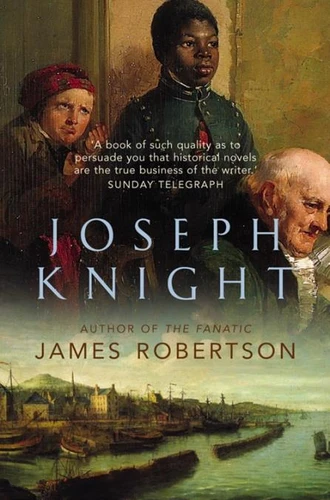
Joseph Knight
Par :Formats :
Disponible dans votre compte client Decitre ou Furet du Nord dès validation de votre commande. Le format ePub protégé est :
- Compatible avec une lecture sur My Vivlio (smartphone, tablette, ordinateur)
- Compatible avec une lecture sur liseuses Vivlio
- Pour les liseuses autres que Vivlio, vous devez utiliser le logiciel Adobe Digital Edition. Non compatible avec la lecture sur les liseuses Kindle, Remarkable et Sony
- Non compatible avec un achat hors France métropolitaine
 , qui est-ce ?
Notre partenaire de plateforme de lecture numérique où vous retrouverez l'ensemble de vos ebooks gratuitement
Pour en savoir plus sur nos ebooks, consultez notre aide en ligne ici
C'est si simple ! Lisez votre ebook avec l'app Vivlio sur votre tablette, mobile ou ordinateur :

- Nombre de pages384
- FormatePub
- ISBN978-0-00-737426-7
- EAN9780007374267
- Date de parution20/06/2013
- Protection num.Adobe DRM
- Infos supplémentairesepub
- ÉditeurFourth Estate
Résumé
'A book of such quality as to persuade you that historical novels are the true business of the writer.'Daily Telegraph
A gripping, shocking story of history, enlightement and slavery from the bestselling author of THE FANATIC. JOSEPH KNIGHT confirms James Robertson as one of our foremost novelists.
Exiled to Jamaica after the Battle of Culloden in 1746, Sir John Wedderburn made a fortune, alongside his three brothers, as a faux surgeon and sugar planter.
In the 1770s, he returned to Scotland to marry and re-establish the family name. He brought with him Joseph Knight, a black slave and a token of his years in the Caribbean. Now, in 1802, Sir John Wedderburn is settling his estate, and has hired a solicitor's agent, Archibald Jamieson, to search for his former slave. The past has haunted Wedderburn ever since Culloden, and ever since he last saw Knight, in court twenty-four years ago, in a case that went to the heart of Scottish society, pitting master against slave, white against black, and rich against poor. As long as Knight is missing, Wedderburn will never be able to escape the past.
Yet what will he do if Jamieson's search is successful? And what effect will this re-opening of old wounds have on those around him? Meanwhile, as Jamieson tries to unravel the true story of Joseph Knight he begins to question his own motivation. How can he possibly find a man who does not want to be found? James Robertson's second novel is a tour de force, the gripping story of a search for a life that stretches over sixty years and moves from battlefields to the plantations of Jamaica, from Enlightenment Edinburgh to the back streets of Dundee.
It is a moving narrative of history, identity and ideas, that dramatically retells a fascinating but forgotten episode of Scottish history.
In the 1770s, he returned to Scotland to marry and re-establish the family name. He brought with him Joseph Knight, a black slave and a token of his years in the Caribbean. Now, in 1802, Sir John Wedderburn is settling his estate, and has hired a solicitor's agent, Archibald Jamieson, to search for his former slave. The past has haunted Wedderburn ever since Culloden, and ever since he last saw Knight, in court twenty-four years ago, in a case that went to the heart of Scottish society, pitting master against slave, white against black, and rich against poor. As long as Knight is missing, Wedderburn will never be able to escape the past.
Yet what will he do if Jamieson's search is successful? And what effect will this re-opening of old wounds have on those around him? Meanwhile, as Jamieson tries to unravel the true story of Joseph Knight he begins to question his own motivation. How can he possibly find a man who does not want to be found? James Robertson's second novel is a tour de force, the gripping story of a search for a life that stretches over sixty years and moves from battlefields to the plantations of Jamaica, from Enlightenment Edinburgh to the back streets of Dundee.
It is a moving narrative of history, identity and ideas, that dramatically retells a fascinating but forgotten episode of Scottish history.
A propos de James Robertson

News of the Dead
E-book
14,99 €
To Be Continued
E-book
8,99 €
365. Stories
E-book
10,99 €
The Professor of Truth
E-book
8,99 €
Scottish Ghost Stories
E-book
3,99 €
The Fanatic
E-book
6,99 €