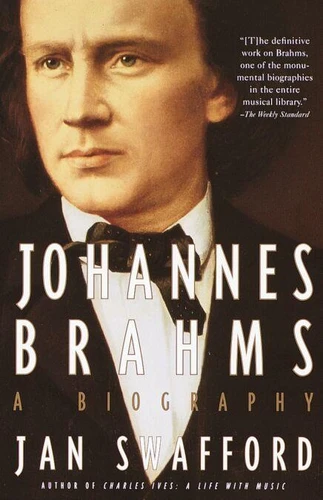
An illuminating new biography of one of the most beloved of all composers, published on the hundredth anniversary of his death, brilliantly written by a finalist for the 1996 National Book Critics Circle Award. Johannes Brahms has consistently eluded his biographers. Throughout his life, he attempted to erase traces of himself, wanting his music to be his sole legacy. Now, in this masterful book, Jan Swafford, critically acclaimed as both biographer and composer, takes a fresh look at Brahms, giving us for the first time a fully realized portrait of the man who created the magnificent music.
Brahms was a man with many friends and no intimates, who experienced triumphs few artists achieve in their lifetime. Yet he lived with a relentless loneliness and a growing fatalism about the future of music and the world. The Brahms that emerges from these pages is not the bearded eminence of previous biographies but rather a fascinating assemblage of contradictions. Brought up in poverty, he was forced to play the piano in the brothels of Hamburg, where he met with both mental and physical abuse.
At the same time, he was the golden boy of his teachers, who found themselves in awe of a stupendous talent: a miraculous young composer and pianist, poised between the emotionalism of the Romantics and the rigors of the composers he worshipped--Bach, Mozart, Beethoven. In 1853, Robert Schumann proclaimed the twenty-year-old Brahms the savior of German music. Brahms spent the rest of his days trying to live up to that prophecy, ever fearful of proving unworthy of his musical inheritance. We find here more of Brahms's words, his daily life and joys and sorrows, than in any other biography. With novelistic grace, Swafford shows us a warm-blooded but guarded genius who hid behind jokes and prickliness, rudeness and intractability with his friends as well as his enemies, but who was also a witty drinking companion and a consummate careerist skillfully courting the powerful.
This is a book rich in secondary characters as well, including Robert Schumann, declining into madness as he hailed the advent of a new genius; Clara Schumann, the towering pianist, tormented personality, and great love of Brahms's life; Josef Joachim, the brilliant, self-lacerating violinist; the extraordinary musical amateur Elisabet von Herzogenberg, on whose exacting criticism Brahms relied; Brahms's rival and shadow, the malevolent genius Richard Wagner; and Eduard Hanslick, enemy of Wagner and apostle of Brahms, at once the most powerful and most wrongheaded music critic of his time.
Among the characters in the book are two great cities: the stolid North German harbor town of Hamburg where Johannes grew up, which later spurned him; and glittering, fickle, music-mad Vienna, where Brahms the self-proclaimed vagabond finally settled, to find his sweetest triumphs and his most bitter failures. Unique to this book is the way in which musical scholarship and biography are combined: in a style refreshingly free of pretentiousness, Jan Swafford takes us deep into the music--from the grandeur of the First Symphony and the intricacies of the chamber work to the sorrow of the German Requiem--allowing us to hear these familiar works in new and often surprising ways. This is a clear-eyed study of a remarkable man and a vivid portrait of an era in transition.
Ultimately, Johannes Brahms is the story of a great, backward-looking artist who inspired musical revolutionaries of the following generations, yet who was no less a prophet of the darkness and violence of our century. A biographical masterpiece at once wholly original and definitive.
An illuminating new biography of one of the most beloved of all composers, published on the hundredth anniversary of his death, brilliantly written by a finalist for the 1996 National Book Critics Circle Award. Johannes Brahms has consistently eluded his biographers. Throughout his life, he attempted to erase traces of himself, wanting his music to be his sole legacy. Now, in this masterful book, Jan Swafford, critically acclaimed as both biographer and composer, takes a fresh look at Brahms, giving us for the first time a fully realized portrait of the man who created the magnificent music.
Brahms was a man with many friends and no intimates, who experienced triumphs few artists achieve in their lifetime. Yet he lived with a relentless loneliness and a growing fatalism about the future of music and the world. The Brahms that emerges from these pages is not the bearded eminence of previous biographies but rather a fascinating assemblage of contradictions. Brought up in poverty, he was forced to play the piano in the brothels of Hamburg, where he met with both mental and physical abuse.
At the same time, he was the golden boy of his teachers, who found themselves in awe of a stupendous talent: a miraculous young composer and pianist, poised between the emotionalism of the Romantics and the rigors of the composers he worshipped--Bach, Mozart, Beethoven. In 1853, Robert Schumann proclaimed the twenty-year-old Brahms the savior of German music. Brahms spent the rest of his days trying to live up to that prophecy, ever fearful of proving unworthy of his musical inheritance. We find here more of Brahms's words, his daily life and joys and sorrows, than in any other biography. With novelistic grace, Swafford shows us a warm-blooded but guarded genius who hid behind jokes and prickliness, rudeness and intractability with his friends as well as his enemies, but who was also a witty drinking companion and a consummate careerist skillfully courting the powerful.
This is a book rich in secondary characters as well, including Robert Schumann, declining into madness as he hailed the advent of a new genius; Clara Schumann, the towering pianist, tormented personality, and great love of Brahms's life; Josef Joachim, the brilliant, self-lacerating violinist; the extraordinary musical amateur Elisabet von Herzogenberg, on whose exacting criticism Brahms relied; Brahms's rival and shadow, the malevolent genius Richard Wagner; and Eduard Hanslick, enemy of Wagner and apostle of Brahms, at once the most powerful and most wrongheaded music critic of his time.
Among the characters in the book are two great cities: the stolid North German harbor town of Hamburg where Johannes grew up, which later spurned him; and glittering, fickle, music-mad Vienna, where Brahms the self-proclaimed vagabond finally settled, to find his sweetest triumphs and his most bitter failures. Unique to this book is the way in which musical scholarship and biography are combined: in a style refreshingly free of pretentiousness, Jan Swafford takes us deep into the music--from the grandeur of the First Symphony and the intricacies of the chamber work to the sorrow of the German Requiem--allowing us to hear these familiar works in new and often surprising ways. This is a clear-eyed study of a remarkable man and a vivid portrait of an era in transition.
Ultimately, Johannes Brahms is the story of a great, backward-looking artist who inspired musical revolutionaries of the following generations, yet who was no less a prophet of the darkness and violence of our century. A biographical masterpiece at once wholly original and definitive.


 , qui est-ce ?