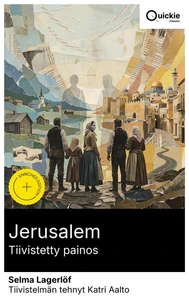
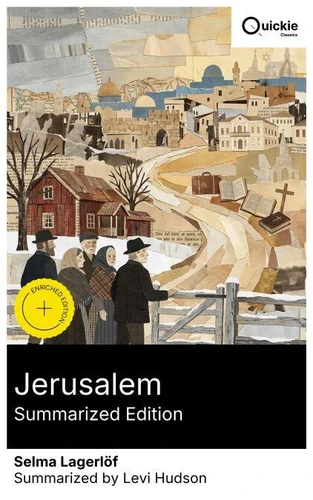
Jerusalem moves from the snow-laden farms of Dalarna to the sunstruck alleys of the Holy City, following Swedish villagers who, seized by millenarian fervor, leave for the American Colony in Palestine. In supple, omniscient prose melding folkloric cadence with psychological realism, Lagerlöf fashions an epic of faith, doubt, love, and property, balancing ethnographic precision with parabolic breadth to probe charisma, communal experiment, and the costs of salvation.
Lagerlöf-a schoolteacher turned novelist and later the first woman to win the Nobel Prize in Literature-built the book on scrupulous inquiry. She interviewed emigrants from Nås and, traveling with Sophie Elkan in 1899-1900, visited the Levant and the American Colony. Her Värmland storytelling heritage and interest in revivalism and exile shape the novel's poised sympathy for both believers and the skeptics they leave behind.
Recommended to readers of historical fiction, religious studies, and Scandinavian letters, Jerusalem offers a humane, unsentimental anatomy of spiritual passion, migration, and modernity's pressures on rural life. Its moral clarity, narrative amplitude, and feeling for ordinary lives make it a work to study, debate, and treasure.
Quickie Classics summarizes timeless works with precision, preserving the author's voice and keeping the prose clear, fast, and readable-distilled, never diluted.
Enriched Edition extras: Introduction · Synopsis · Historical Context · Author Biography · Brief Analysis · 4 Reflection Q&As · Editorial Footnotes.
Jerusalem moves from the snow-laden farms of Dalarna to the sunstruck alleys of the Holy City, following Swedish villagers who, seized by millenarian fervor, leave for the American Colony in Palestine. In supple, omniscient prose melding folkloric cadence with psychological realism, Lagerlöf fashions an epic of faith, doubt, love, and property, balancing ethnographic precision with parabolic breadth to probe charisma, communal experiment, and the costs of salvation.
Lagerlöf-a schoolteacher turned novelist and later the first woman to win the Nobel Prize in Literature-built the book on scrupulous inquiry. She interviewed emigrants from Nås and, traveling with Sophie Elkan in 1899-1900, visited the Levant and the American Colony. Her Värmland storytelling heritage and interest in revivalism and exile shape the novel's poised sympathy for both believers and the skeptics they leave behind.
Recommended to readers of historical fiction, religious studies, and Scandinavian letters, Jerusalem offers a humane, unsentimental anatomy of spiritual passion, migration, and modernity's pressures on rural life. Its moral clarity, narrative amplitude, and feeling for ordinary lives make it a work to study, debate, and treasure.
Quickie Classics summarizes timeless works with precision, preserving the author's voice and keeping the prose clear, fast, and readable-distilled, never diluted.
Enriched Edition extras: Introduction · Synopsis · Historical Context · Author Biography · Brief Analysis · 4 Reflection Q&As · Editorial Footnotes.

 , qui est-ce ?