
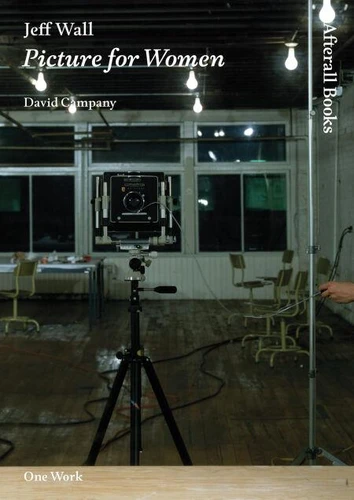
Jeff Wall. Picture for Women
Par :Formats :
Disponible dans votre compte client Decitre ou Furet du Nord dès validation de votre commande. Le format ePub protégé est :
- Compatible avec une lecture sur My Vivlio (smartphone, tablette, ordinateur)
- Compatible avec une lecture sur liseuses Vivlio
- Pour les liseuses autres que Vivlio, vous devez utiliser le logiciel Adobe Digital Edition. Non compatible avec la lecture sur les liseuses Kindle, Remarkable et Sony
- Non compatible avec un achat hors France métropolitaine
 , qui est-ce ?
Notre partenaire de plateforme de lecture numérique où vous retrouverez l'ensemble de vos ebooks gratuitement
Pour en savoir plus sur nos ebooks, consultez notre aide en ligne ici
C'est si simple ! Lisez votre ebook avec l'app Vivlio sur votre tablette, mobile ou ordinateur :

- Nombre de pages118
- FormatePub
- ISBN978-1-84638-178-2
- EAN9781846381782
- Date de parution27/05/2011
- Protection num.Adobe DRM
- Taille10 Mo
- Infos supplémentairesepub
- ÉditeurAfterall Books
Résumé
Examining a work that marked the emergence of photography as an art made for the gallery wall instead of the printed page. Jeff Wall's Picture for Women (1979) marks the transition of photography as an art form from the printed page to the gallery wall. Before this, photographs-from the orthodox photographic work of Walker Evans to the Conceptual photography of Dan Graham-seemed intended for the page even when hung in a gallery.
In Picture for Women, a woman looks outward, as if at the viewer; a camera occupies the center of the photograph; the photographer stands on the right. Modeled on Manet's famous painting Un bar aux Folies-Bergère, in which a barmaid seems to look directly out of the painting, observed by a man on the right, Picture for Women establishes its own art historical genealogy, claiming its rightful position within the canon.
Wall's photograph is an ambitious attempt to relate the artistic and spectatorial demands of the late 1970s to a modernist pictorial art that had been too hastily rejected by Conceptualism. In this illustrated study, David Campany offers an account of Wall's move from a Conceptual approach to a reengagement with the idea of a singular (as opposed to serial) picture. He shows that Wall's decision to present his work as a large-scale back-lit transparency, together with his commitment to a singular image, amounted to a radical departure.
He contrasts Wall's idea of the photograph as a tableau or "picture, " inherited from the history of painting, with the works of the "Pictures Generation" - including Richard Prince, Cindy Sherman, and Jack Goldstein-and argues that Picture for Women is inseparable from the modern fate of the picture in general
In Picture for Women, a woman looks outward, as if at the viewer; a camera occupies the center of the photograph; the photographer stands on the right. Modeled on Manet's famous painting Un bar aux Folies-Bergère, in which a barmaid seems to look directly out of the painting, observed by a man on the right, Picture for Women establishes its own art historical genealogy, claiming its rightful position within the canon.
Wall's photograph is an ambitious attempt to relate the artistic and spectatorial demands of the late 1970s to a modernist pictorial art that had been too hastily rejected by Conceptualism. In this illustrated study, David Campany offers an account of Wall's move from a Conceptual approach to a reengagement with the idea of a singular (as opposed to serial) picture. He shows that Wall's decision to present his work as a large-scale back-lit transparency, together with his commitment to a singular image, amounted to a radical departure.
He contrasts Wall's idea of the photograph as a tableau or "picture, " inherited from the history of painting, with the works of the "Pictures Generation" - including Richard Prince, Cindy Sherman, and Jack Goldstein-and argues that Picture for Women is inseparable from the modern fate of the picture in general
A propos de David Campany
Between worlds
Beau Livre
49,00 €
Fred Herzog modern color
Beau Livre
40,00 €
49,00 €

Eboro
Grand Format
45,00 €
Sur des photographies
Grand Format
29,90 €
29,95 €