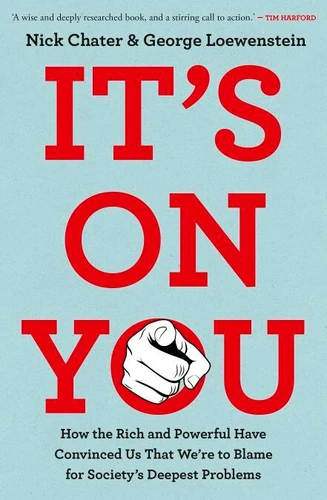
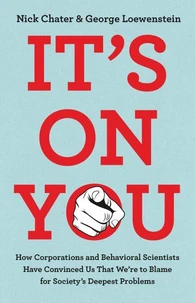
It's On You. How the Rich and Powerful Have Convinced Us that We're to Blame for Society's Deepest Problems
Par : ,Formats :
Disponible dans votre compte client Decitre ou Furet du Nord dès validation de votre commande. Le format ePub protégé est :
- Compatible avec une lecture sur My Vivlio (smartphone, tablette, ordinateur)
- Compatible avec une lecture sur liseuses Vivlio
- Pour les liseuses autres que Vivlio, vous devez utiliser le logiciel Adobe Digital Edition. Non compatible avec la lecture sur les liseuses Kindle, Remarkable et Sony
- Non compatible avec un achat hors France métropolitaine
 , qui est-ce ?
Notre partenaire de plateforme de lecture numérique où vous retrouverez l'ensemble de vos ebooks gratuitement
Pour en savoir plus sur nos ebooks, consultez notre aide en ligne ici
C'est si simple ! Lisez votre ebook avec l'app Vivlio sur votre tablette, mobile ou ordinateur :

- Nombre de pages352
- FormatePub
- ISBN978-0-7535-6218-5
- EAN9780753562185
- Date de parution27/01/2026
- Protection num.Adobe DRM
- Infos supplémentairesepub
- ÉditeurVirgin Digital
Résumé
'A stirring call to action' - TIM HARFORD'A masterclass' - DARON ACEMOGLU'An excellent book' - NASSIM NICHOLAS TALEBTwo decades ago, behavioral economics burst from academia to the halls of power, on both sides of the Atlantic, with the promise that correcting individual biases could help transform society. The hope was that governments could deploy a new approach to addressing society's deepest challenges, from inadequate retirement planning to climate change-gently, but cleverly, nudging people to make choices for their own good and the good of the planet.
It was all very convenient, and false. As behavioral scientists Nick Chater and George Loewenstein show in It's On You, nudges rarely work, and divert us from policies that do. For example, being nudged to switch to green energy doesn't cut carbon, and it distracts from the real challenge of building a low-carbon economy. It's on You shows how the rich and powerful have repeatedly used a clever sleight of hand: blaming individuals for social problems, with behavioral economics an unwitting accomplice, while lobbying against the systemic changes that could actually help.
As two original proponents of the nudge principle, Nick and George now argue that rather than trying to "fix" the victims of bad policies, real progress requires rewriting the social and economic rulebook for the common good.
It was all very convenient, and false. As behavioral scientists Nick Chater and George Loewenstein show in It's On You, nudges rarely work, and divert us from policies that do. For example, being nudged to switch to green energy doesn't cut carbon, and it distracts from the real challenge of building a low-carbon economy. It's on You shows how the rich and powerful have repeatedly used a clever sleight of hand: blaming individuals for social problems, with behavioral economics an unwitting accomplice, while lobbying against the systemic changes that could actually help.
As two original proponents of the nudge principle, Nick and George now argue that rather than trying to "fix" the victims of bad policies, real progress requires rewriting the social and economic rulebook for the common good.
A propos de Nick Chater


13,99 €