David Campbell received his doctorate in history from the University of Calgary, specializing in military history. He lives in Halifax, Nova Scotia, and teaches history at Mount Saint Vincent University and Saint Mary's University.
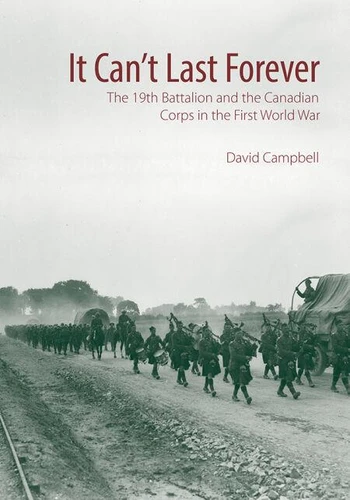
It Can't Last Forever. The 19th Battalion and the Canadian Corps in the First World War
Par :Formats :
Disponible dans votre compte client Decitre ou Furet du Nord dès validation de votre commande. Le format ePub est :
- Compatible avec une lecture sur My Vivlio (smartphone, tablette, ordinateur)
- Compatible avec une lecture sur liseuses Vivlio
- Pour les liseuses autres que Vivlio, vous devez utiliser le logiciel Adobe Digital Edition. Non compatible avec la lecture sur les liseuses Kindle, Remarkable et Sony
 , qui est-ce ?
Notre partenaire de plateforme de lecture numérique où vous retrouverez l'ensemble de vos ebooks gratuitement
Pour en savoir plus sur nos ebooks, consultez notre aide en ligne ici
C'est si simple ! Lisez votre ebook avec l'app Vivlio sur votre tablette, mobile ou ordinateur :

- Nombre de pages512
- FormatePub
- ISBN978-1-77112-254-2
- EAN9781771122542
- Date de parution12/10/2017
- Protection num.Digital Watermarking
- Taille61 Mo
- Infos supplémentairesepub
- ÉditeurWilfrid Laurier University Press
Résumé
The 19th Battalion was an infantry unit that fought in many of the deadliest battles of the First World War. Hailing from Hamilton, Toronto, and other communities in southern Ontario and beyond, its members were ordinary men facing extraordinary challenges at the Somme, Vimy Ridge, Passchendaele, Amiens, and other battlefields on Europe's Western Front. Through his examination of official records and personal accounts, the author presents vivid descriptions and assessments of the rigours of training, the strains of trench warfare, the horrors of battle, and the camaraderie of life behind the front lines.
From mobilization in 1914 to the return home in 1919, Campbell reveals the unique experiences of the battalion's officers and men and situates their service within the broader context of the battalion's parent formations-the 4th Infantry Brigade and the 2nd Division of the Canadian Corps. Readers will gain a fuller appreciation of the internal dynamics of an infantry battalion and how it functioned within the larger picture of Canadian operations.
From mobilization in 1914 to the return home in 1919, Campbell reveals the unique experiences of the battalion's officers and men and situates their service within the broader context of the battalion's parent formations-the 4th Infantry Brigade and the 2nd Division of the Canadian Corps. Readers will gain a fuller appreciation of the internal dynamics of an infantry battalion and how it functioned within the larger picture of Canadian operations.
A propos de David Campbell

15,90 €

A Deep-Sworn Vow (Unabridged)
Audiobook
5,49 €