
Umm Zakiyyah is the bestselling author of the novels If I Should Speak trilogy, Muslim Girl, and His Other Wife; and the self-help book for religious survivors of abuse Reverencing the Wombs That Broke You. She writes about the interfaith struggles of Muslims and Christians and the intercultural, spiritual, and moral struggles of Muslims in America. Her work has earned praise from writers, professors, and filmmakers and has been translated into multiple languages.
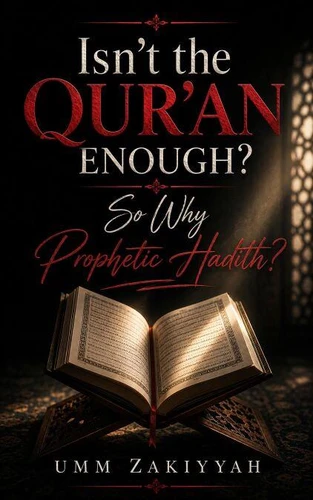
Isn’t the Qur’an Enough? So Why Prophetic Hadith?
Par :Formats :
Disponible dans votre compte client Decitre ou Furet du Nord dès validation de votre commande. Le format ePub est :
- Compatible avec une lecture sur My Vivlio (smartphone, tablette, ordinateur)
- Compatible avec une lecture sur liseuses Vivlio
- Pour les liseuses autres que Vivlio, vous devez utiliser le logiciel Adobe Digital Edition. Non compatible avec la lecture sur les liseuses Kindle, Remarkable et Sony
 , qui est-ce ?
Notre partenaire de plateforme de lecture numérique où vous retrouverez l'ensemble de vos ebooks gratuitement
Pour en savoir plus sur nos ebooks, consultez notre aide en ligne ici
C'est si simple ! Lisez votre ebook avec l'app Vivlio sur votre tablette, mobile ou ordinateur :

- Date de parution08/02/2027
- FormatePub
- ISBN8235404205
- EAN9798235404205
- Protection num.pas de protection
- Infos supplémentairesepub
- ÉditeurIoakim Ioakim
Résumé
Religious trauma is real. Muslims today are facing a very real spiritual dilemma as a result of the toxic, damaging ways that our faith is taught and understood in religious spaces, much of which is justified through prophetic hadith. Consequently, Muslim men and women feel increasingly compelled to protect their souls by any means necessary. For some, this means accepting as part of their faith only what can be found explicitly in the Qur'an.
Thus, they reject the practical relevance and religious authority of any spiritual guidance found in hadith books. Yet there is a striking contradiction at the heart of this claim: In rejecting prophetic hadith because it comes to us through human-transmitted reports and narrations, they inevitably rely on other human-generated speech and narrations to tell us what the Qur'an means, what Allah requires, and how Islam should be practiced. In other words, they do not actually reject non-Qur'anic hadith.
They replace prophetic hadith with their own.
Thus, they reject the practical relevance and religious authority of any spiritual guidance found in hadith books. Yet there is a striking contradiction at the heart of this claim: In rejecting prophetic hadith because it comes to us through human-transmitted reports and narrations, they inevitably rely on other human-generated speech and narrations to tell us what the Qur'an means, what Allah requires, and how Islam should be practiced. In other words, they do not actually reject non-Qur'anic hadith.
They replace prophetic hadith with their own.
A propos de Umm Zakiyyah

3,99 €
4,99 €
3,99 €
0,99 €
3,99 €
0,99 €
0,99 €