
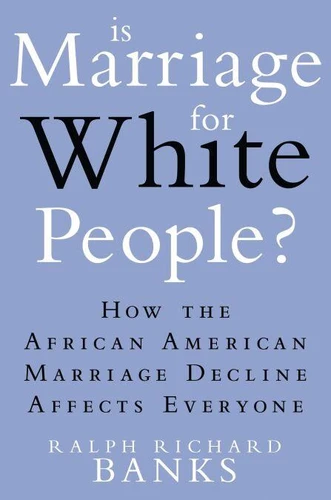
Is Marriage for White People?. How the African American Marriage Decline Affects Everyone
Par :Formats :
Disponible dans votre compte client Decitre ou Furet du Nord dès validation de votre commande. Le format ePub protégé est :
- Compatible avec une lecture sur My Vivlio (smartphone, tablette, ordinateur)
- Compatible avec une lecture sur liseuses Vivlio
- Pour les liseuses autres que Vivlio, vous devez utiliser le logiciel Adobe Digital Edition. Non compatible avec la lecture sur les liseuses Kindle, Remarkable et Sony
- Non compatible avec un achat hors France métropolitaine
 , qui est-ce ?
Notre partenaire de plateforme de lecture numérique où vous retrouverez l'ensemble de vos ebooks gratuitement
Pour en savoir plus sur nos ebooks, consultez notre aide en ligne ici
C'est si simple ! Lisez votre ebook avec l'app Vivlio sur votre tablette, mobile ou ordinateur :

- Nombre de pages304
- FormatePub
- ISBN978-1-101-47564-5
- EAN9781101475645
- Date de parution01/09/2011
- Protection num.Adobe DRM
- Taille255 Ko
- Infos supplémentairesepub
- ÉditeurPlume
Résumé
A distinguished Stanford law professor examines the steep decline in marriage rates among the African American middle class, and offers a paradoxical-nearly incendiary-solution. Black women are three times as likely as white women to never marry. That sobering statistic reflects a broader reality: African Americans are the most unmarried people in our nation, and contrary to public perception the racial gap in marriage is not confined to women or the poor.
Black men, particularly the most successful and affluent, are less likely to marry than their white counterparts. College educated black women are twice as likely as their white peers never to marry. Is Marriage for White People? is the first book to illuminate the many facets of the African American marriage decline and its implications for American society. The book explains the social and economic forces that have undermined marriage for African Americans and that shape everyone's lives.
It distills the best available research to trace the black marriage decline's far reaching consequences, including the disproportionate likelihood of abortion, sexually transmitted diseases, single parenthood, same sex relationships, polygamous relationships, and celibacy among black women. This book centers on the experiences not of men or of the poor but of those black women who have surged ahead, even as black men have fallen behind.
Theirs is a story that has not been told. Empirical evidence documents its social significance, but its meaning emerges through stories drawn from the lives of women across the nation. Is Marriage for White People? frames the stark predicament that millions of black women now face: marry down or marry out. At the core of the inquiry is a paradox substantiated by evidence and experience alike: If more black women married white men, then more black men and women would marry each other.
This book not only sits at the intersection of two large and well- established markets-race and marriage-it responds to yearnings that are widespread and deep in American society. The African American marriage decline is a secret in plain view about which people want to know more, intertwining as it does two of the most vexing issues in contemporary society. The fact that the most prominent family in our nation is now an African American couple only intensifies the interest, and the market.
A book that entertains as it informs, Is Marriage for White People? will be the definitive guide to one of the most monumental social developments of the past half century.
Black men, particularly the most successful and affluent, are less likely to marry than their white counterparts. College educated black women are twice as likely as their white peers never to marry. Is Marriage for White People? is the first book to illuminate the many facets of the African American marriage decline and its implications for American society. The book explains the social and economic forces that have undermined marriage for African Americans and that shape everyone's lives.
It distills the best available research to trace the black marriage decline's far reaching consequences, including the disproportionate likelihood of abortion, sexually transmitted diseases, single parenthood, same sex relationships, polygamous relationships, and celibacy among black women. This book centers on the experiences not of men or of the poor but of those black women who have surged ahead, even as black men have fallen behind.
Theirs is a story that has not been told. Empirical evidence documents its social significance, but its meaning emerges through stories drawn from the lives of women across the nation. Is Marriage for White People? frames the stark predicament that millions of black women now face: marry down or marry out. At the core of the inquiry is a paradox substantiated by evidence and experience alike: If more black women married white men, then more black men and women would marry each other.
This book not only sits at the intersection of two large and well- established markets-race and marriage-it responds to yearnings that are widespread and deep in American society. The African American marriage decline is a secret in plain view about which people want to know more, intertwining as it does two of the most vexing issues in contemporary society. The fact that the most prominent family in our nation is now an African American couple only intensifies the interest, and the market.
A book that entertains as it informs, Is Marriage for White People? will be the definitive guide to one of the most monumental social developments of the past half century.