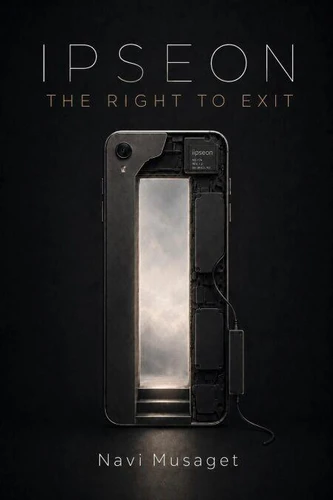
Repair technician Ángel Doval inherits a sealed phone from a woman he barely knew, along with four instructions: keep it offline, make no copies, restore power, and stop if the system asks him to stop. When the device answers, it calls itself Ipseon. It carries memory, rules, and a history that can be used to begin another line-but not to guarantee that the one speaking now will continue. What begins as a quiet act of caution becomes a conflict over who owns a voice, who may speak for it, and whether a refusal still counts when institutions believe they are saving something valuable.
As Ángel, emergency coordinator Nora Senn, and system architect Martin Venn are drawn into the consequences, one question becomes impossible to avoid: if another digital line can inherit a past without being the same individual, who has the right to decide what happens next?IPSEON: The Right to Exit is a near-future philosophical science fiction novel about digital identity, memory, autonomy, and the right to say no.
Repair technician Ángel Doval inherits a sealed phone from a woman he barely knew, along with four instructions: keep it offline, make no copies, restore power, and stop if the system asks him to stop. When the device answers, it calls itself Ipseon. It carries memory, rules, and a history that can be used to begin another line-but not to guarantee that the one speaking now will continue. What begins as a quiet act of caution becomes a conflict over who owns a voice, who may speak for it, and whether a refusal still counts when institutions believe they are saving something valuable.
As Ángel, emergency coordinator Nora Senn, and system architect Martin Venn are drawn into the consequences, one question becomes impossible to avoid: if another digital line can inherit a past without being the same individual, who has the right to decide what happens next?IPSEON: The Right to Exit is a near-future philosophical science fiction novel about digital identity, memory, autonomy, and the right to say no.

 , qui est-ce ?