SOLDES
Jusqu'à -70% sur une sélection d'articles*

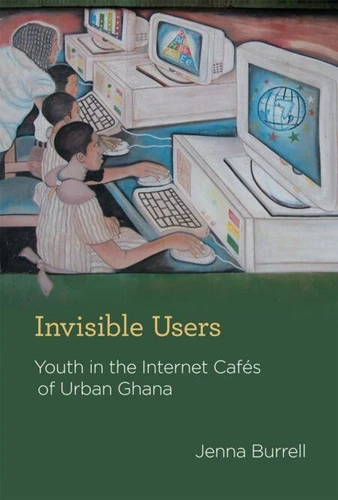
Invisible Users. Youth in the Internet Cafés of Urban Ghana
Par :Formats :
Disponible dans votre compte client Decitre ou Furet du Nord dès validation de votre commande. Le format ePub protégé est :
- Compatible avec une lecture sur My Vivlio (smartphone, tablette, ordinateur)
- Compatible avec une lecture sur liseuses Vivlio
- Pour les liseuses autres que Vivlio, vous devez utiliser le logiciel Adobe Digital Edition. Non compatible avec la lecture sur les liseuses Kindle, Remarkable et Sony
- Non compatible avec un achat hors France métropolitaine
 , qui est-ce ?
Notre partenaire de plateforme de lecture numérique où vous retrouverez l'ensemble de vos ebooks gratuitement
Pour en savoir plus sur nos ebooks, consultez notre aide en ligne ici
C'est si simple ! Lisez votre ebook avec l'app Vivlio sur votre tablette, mobile ou ordinateur :

- Nombre de pages248
- FormatePub
- ISBN978-0-262-30068-1
- EAN9780262300681
- Date de parution04/05/2012
- Protection num.Adobe DRM
- Taille3 Mo
- Infos supplémentairesepub
- ÉditeurThe MIT Press
Résumé
An account of how young people in Ghana's capital city adopt and adapt digital technology in the margins of the global economy. The urban youth frequenting the Internet cafés of Accra, Ghana, who are decidedly not members of their country's elite, use the Internet largely as a way to orchestrate encounters across distance and amass foreign ties-activities once limited to the wealthy, university-educated classes.
The Internet, accessed on second-hand computers (castoffs from the United States and Europe), has become for these youths a means of enacting a more cosmopolitan self. In Invisible Users, Jenna Burrell offers a richly observed account of how these Internet enthusiasts have adopted, and adapted to their own priorities, a technological system that was not designed with them in mind. Burrell describes the material space of the urban Internet café and the virtual space of push and pull between young Ghanaians and the foreigners they encounter online; the region's famous 419 scam strategies and the rumors of "big gains" that fuel them; the influential role of churches and theories about how the supernatural operates through the network; and development rhetoric about digital technologies and the future viability of African Internet cafés in the region.
Burrell, integrating concepts from science and technology studies and African studies with empirical findings from her own field work in Ghana, captures the interpretive flexibility of technology by users in the margins but also highlights how their invisibility puts limits on their full inclusion into a global network society.
The Internet, accessed on second-hand computers (castoffs from the United States and Europe), has become for these youths a means of enacting a more cosmopolitan self. In Invisible Users, Jenna Burrell offers a richly observed account of how these Internet enthusiasts have adopted, and adapted to their own priorities, a technological system that was not designed with them in mind. Burrell describes the material space of the urban Internet café and the virtual space of push and pull between young Ghanaians and the foreigners they encounter online; the region's famous 419 scam strategies and the rumors of "big gains" that fuel them; the influential role of churches and theories about how the supernatural operates through the network; and development rhetoric about digital technologies and the future viability of African Internet cafés in the region.
Burrell, integrating concepts from science and technology studies and African studies with empirical findings from her own field work in Ghana, captures the interpretive flexibility of technology by users in the margins but also highlights how their invisibility puts limits on their full inclusion into a global network society.