SOLDES
Jusqu'à -70% sur une sélection d'articles*

Nouveauté
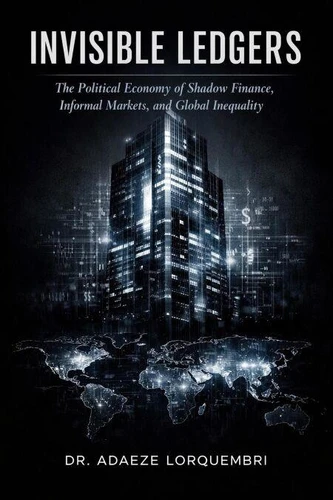
Invisible Ledgers: The Political Economy of Shadow Finance, Informal Markets, and Global Inequality
Par :Formats :
Disponible dans votre compte client Decitre ou Furet du Nord dès validation de votre commande. Le format ePub est :
- Compatible avec une lecture sur My Vivlio (smartphone, tablette, ordinateur)
- Compatible avec une lecture sur liseuses Vivlio
- Pour les liseuses autres que Vivlio, vous devez utiliser le logiciel Adobe Digital Edition. Non compatible avec la lecture sur les liseuses Kindle, Remarkable et Sony
 , qui est-ce ?
Notre partenaire de plateforme de lecture numérique où vous retrouverez l'ensemble de vos ebooks gratuitement
Pour en savoir plus sur nos ebooks, consultez notre aide en ligne ici
C'est si simple ! Lisez votre ebook avec l'app Vivlio sur votre tablette, mobile ou ordinateur :

- FormatePub
- ISBN8233988981
- EAN9798233988981
- Date de parution21/05/2026
- Protection num.pas de protection
- Infos supplémentairesepub
- ÉditeurLinda Balsamo
Résumé
INVISIBLE LEDGERS The Political Economy of Shadow Finance, Informal Markets, and Global InequalityThe global economy keeps two sets of books. Every government publishes one. Nobody publishes the other. This book does. Somewhere between the street vendors of Lagos and the law firms of the Cayman Islands, between the copper mines of Zambia and the trading subsidiaries of Zurich, an invisible financial architecture moves trillions of dollars beyond the reach of the governments, workers, and citizens who should benefit from them.
It is not hidden by accident. It was built that way: carefully, legally, and by people with every incentive to keep it exactly as it is. Africa loses more wealth every year through illicit financial outflows than it receives in foreign aid and investment combined. The shadow banking system that collapsed the global economy in 2008 is larger today than it was before the crash. Two billion workers fuel cities across the developing world without appearing in a single employment statistic or receiving a single day of social protection.
A multinational corporation can extract a nation's natural resources, sell them to itself through a Swiss subsidiary, and ensure the host government collects tax on a profit margin approaching zero. All without breaking a law. These are not isolated scandals. They are features of a system. Invisible Ledgers is a precise, unflinching investigation into the shadow banking network, the offshore secrecy industry, and the vast informal economies that together constitute the most consequential untold story in global finance.
Drawing on data from the IMF, the World Bank, the OECD, the Tax Justice Network, and the landmark Panama and Pandora Papers investigations, Dr. Adaeze Lorquembri traces how capital escapes, where it goes, who engineered the escape route, and most importantly, who is left to bear the cost when it vanishes. The writing is sharp. The evidence is real. The argument is impossible to dismiss. This is not a book about greed.
It is a book about architecture: the deliberate design of a global financial system in which the movement of wealth away from those who generate it is not a malfunction but a mechanism. Understanding that mechanism is the first step toward changing it. Some books describe the world as it is reported. This one describes it as it actually works. For readers of Gabriel Zucman, Ha-Joon Chang, and Nicholas Shaxson and for everyone who has ever suspected the official economic story is missing its most important chapter.
It is not hidden by accident. It was built that way: carefully, legally, and by people with every incentive to keep it exactly as it is. Africa loses more wealth every year through illicit financial outflows than it receives in foreign aid and investment combined. The shadow banking system that collapsed the global economy in 2008 is larger today than it was before the crash. Two billion workers fuel cities across the developing world without appearing in a single employment statistic or receiving a single day of social protection.
A multinational corporation can extract a nation's natural resources, sell them to itself through a Swiss subsidiary, and ensure the host government collects tax on a profit margin approaching zero. All without breaking a law. These are not isolated scandals. They are features of a system. Invisible Ledgers is a precise, unflinching investigation into the shadow banking network, the offshore secrecy industry, and the vast informal economies that together constitute the most consequential untold story in global finance.
Drawing on data from the IMF, the World Bank, the OECD, the Tax Justice Network, and the landmark Panama and Pandora Papers investigations, Dr. Adaeze Lorquembri traces how capital escapes, where it goes, who engineered the escape route, and most importantly, who is left to bear the cost when it vanishes. The writing is sharp. The evidence is real. The argument is impossible to dismiss. This is not a book about greed.
It is a book about architecture: the deliberate design of a global financial system in which the movement of wealth away from those who generate it is not a malfunction but a mechanism. Understanding that mechanism is the first step toward changing it. Some books describe the world as it is reported. This one describes it as it actually works. For readers of Gabriel Zucman, Ha-Joon Chang, and Nicholas Shaxson and for everyone who has ever suspected the official economic story is missing its most important chapter.