
Nouveauté
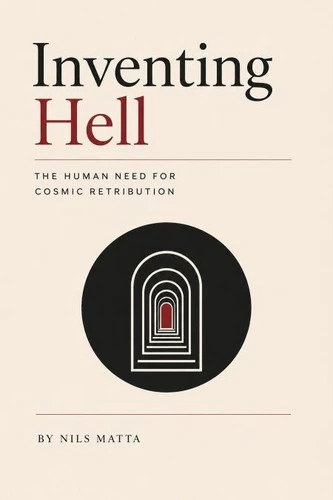
Inventing Hell
Par :Formats :
Disponible dans votre compte client Decitre ou Furet du Nord dès validation de votre commande. Le format ePub est :
- Compatible avec une lecture sur My Vivlio (smartphone, tablette, ordinateur)
- Compatible avec une lecture sur liseuses Vivlio
- Pour les liseuses autres que Vivlio, vous devez utiliser le logiciel Adobe Digital Edition. Non compatible avec la lecture sur les liseuses Kindle, Remarkable et Sony
 , qui est-ce ?
Notre partenaire de plateforme de lecture numérique où vous retrouverez l'ensemble de vos ebooks gratuitement
Pour en savoir plus sur nos ebooks, consultez notre aide en ligne ici
C'est si simple ! Lisez votre ebook avec l'app Vivlio sur votre tablette, mobile ou ordinateur :

- FormatePub
- ISBN8235994409
- EAN9798235994409
- Date de parution31/08/2026
- Protection num.pas de protection
- Infos supplémentairesepub
- ÉditeurIoakim Ioakim
Résumé
Why do human beings, across cultures with no contact, keep inventing an afterlife with teeth?Inventing Hell treats the persistent idea of postmortem punishment not as a single doctrine but as a recurring solution to problems ordinary experience cannot resolve: unanswered injustice, unpayable guilt, the silence of the dead, and a universe that appears indifferent to human moral stakes. Drawing on cognitive science of religion, evolutionary and social psychology, comparative religious history, and philosophy, Nils Matta examines Hell as metaphysical claim, psychological representation, cultural institution, behavioral technology, literary symbol, and existential metaphor-without collapsing them into one another.
Part I maps the underlying human needs: the demand for a moral cosmos, cosmic compensation for earthly failure, the projection of retribution, the externalized conscience, the omniscient witness, mortality anxiety, and the conversion of finite acts into infinite significance. It engages Lerner's just-world research, Norenzayan's Big Gods, Terror Management Theory, Foucault's Panopticon, and the enduring philosophical paradox of eternal punishment.
Part II offers precise comparative portraits of major Hell traditions-Buddhist Narakas as nearly geological karmic processes, Hindu Naraka as bureaucratic metaphysics, Greek Tartarus as cosmic prison, Norse Hel as cold gray ordinary death, Dante's Inferno as moral machine, Tibetan bardo as consciousness itself, Gnostic Earth as the prison, and the Epicurean anti-Hell that simply removes the subject.
Part III turns to the new Hells of modernity and the technological future: prisons and bureaucracies, digital archives and permanent records, algorithmic classification, personalized surveillance, virtual confinement, climate and nuclear eschatology, and speculative posthuman scenarios in which identity, memory, subjective time, and consciousness itself become design variables. The central claim is not prediction but diagnosis: Hell does not disappear when belief in the Devil declines.
It changes technology. Neither a defense of eternal torment nor a simple dismissal of it, Inventing Hell asks why the idea remains so immediately intelligible-and what it reveals about a species that cannot quite bear the possibility that the universe keeps no ledger. For readers of Bart Ehrman, David Bentley Hart, Ernest Becker, Ara Norenzayan, and anyone who has ever wondered why "hell" remains one of the most durable words in the language.
Part I maps the underlying human needs: the demand for a moral cosmos, cosmic compensation for earthly failure, the projection of retribution, the externalized conscience, the omniscient witness, mortality anxiety, and the conversion of finite acts into infinite significance. It engages Lerner's just-world research, Norenzayan's Big Gods, Terror Management Theory, Foucault's Panopticon, and the enduring philosophical paradox of eternal punishment.
Part II offers precise comparative portraits of major Hell traditions-Buddhist Narakas as nearly geological karmic processes, Hindu Naraka as bureaucratic metaphysics, Greek Tartarus as cosmic prison, Norse Hel as cold gray ordinary death, Dante's Inferno as moral machine, Tibetan bardo as consciousness itself, Gnostic Earth as the prison, and the Epicurean anti-Hell that simply removes the subject.
Part III turns to the new Hells of modernity and the technological future: prisons and bureaucracies, digital archives and permanent records, algorithmic classification, personalized surveillance, virtual confinement, climate and nuclear eschatology, and speculative posthuman scenarios in which identity, memory, subjective time, and consciousness itself become design variables. The central claim is not prediction but diagnosis: Hell does not disappear when belief in the Devil declines.
It changes technology. Neither a defense of eternal torment nor a simple dismissal of it, Inventing Hell asks why the idea remains so immediately intelligible-and what it reveals about a species that cannot quite bear the possibility that the universe keeps no ledger. For readers of Bart Ehrman, David Bentley Hart, Ernest Becker, Ara Norenzayan, and anyone who has ever wondered why "hell" remains one of the most durable words in the language.