
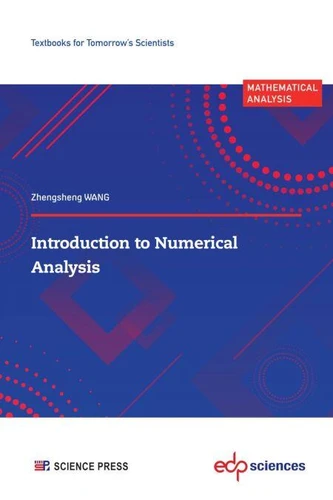
Introduction to Numerical Analysis
Par :Formats :
Disponible dans votre compte client Decitre ou Furet du Nord dès validation de votre commande. Le format PDF est :
- Compatible avec une lecture sur My Vivlio (smartphone, tablette, ordinateur)
- Compatible avec une lecture sur liseuses Vivlio
- Pour les liseuses autres que Vivlio, vous devez utiliser le logiciel Adobe Digital Edition. Non compatible avec la lecture sur les liseuses Kindle, Remarkable et Sony
 , qui est-ce ?
Notre partenaire de plateforme de lecture numérique où vous retrouverez l'ensemble de vos ebooks gratuitement
Pour en savoir plus sur nos ebooks, consultez notre aide en ligne ici
C'est si simple ! Lisez votre ebook avec l'app Vivlio sur votre tablette, mobile ou ordinateur :

- Nombre de pages220
- FormatPDF
- ISBN978-2-7598-3917-9
- EAN9782759839179
- Date de parution21/10/2025
- Protection num.pas de protection
- Taille57 Mo
- Infos supplémentairespdf
- ÉditeurEDP Sciences
Résumé
This book provides essential knowledge and insight into numerical analysis, with an emphasis on developing understanding rather than simply presenting computational recipes. It approaches numerical analysis not only as practical tool for solving applied problems, but also as a rich, challenging and rewarding branch of mathematics. Developed over more than a decade from the author's lecture notes for the undergraduate course Numerical Analysis taught to international students at Nanjing University of Aeronautics and Astronautics (NUAA) since 2005, this textbook is dedicated to readers with a solid foundation in differential and integral calculus and linear algebra.
Equally important, it encourages readers to appreciate how these fundamental tools come to life in solving real-world problems. Written in a clear and self-contained style, the book is designed to be accessible not only to mathematicians, but also to scientists and engineers. It serves as textbook for undergraduate students, while also offering a useful reference for researchers and professionals in engineering and applied sciences.
Equally important, it encourages readers to appreciate how these fundamental tools come to life in solving real-world problems. Written in a clear and self-contained style, the book is designed to be accessible not only to mathematicians, but also to scientists and engineers. It serves as textbook for undergraduate students, while also offering a useful reference for researchers and professionals in engineering and applied sciences.