
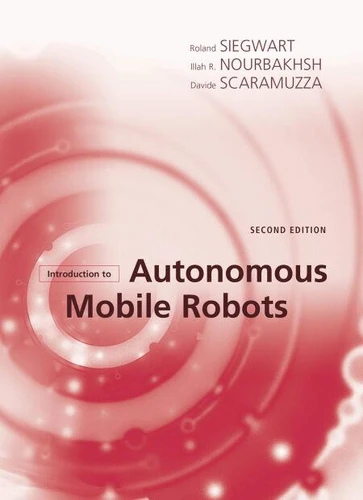
Introduction to Autonomous Mobile Robots
2nd edition
Par : , , Formats :
Disponible dans votre compte client Decitre ou Furet du Nord dès validation de votre commande. Le format ePub protégé est :
- Compatible avec une lecture sur My Vivlio (smartphone, tablette, ordinateur)
- Compatible avec une lecture sur liseuses Vivlio
- Pour les liseuses autres que Vivlio, vous devez utiliser le logiciel Adobe Digital Edition. Non compatible avec la lecture sur les liseuses Kindle, Remarkable et Sony
- Non compatible avec un achat hors France métropolitaine
 , qui est-ce ?
Notre partenaire de plateforme de lecture numérique où vous retrouverez l'ensemble de vos ebooks gratuitement
Pour en savoir plus sur nos ebooks, consultez notre aide en ligne ici
C'est si simple ! Lisez votre ebook avec l'app Vivlio sur votre tablette, mobile ou ordinateur :

- Nombre de pages472
- FormatePub
- ISBN978-0-262-29509-3
- EAN9780262295093
- Date de parution18/02/2011
- Protection num.Adobe DRM
- Taille11 Mo
- Infos supplémentairesepub
- ÉditeurThe MIT Press
Résumé
The second edition of a comprehensive introduction to all aspects of mobile robotics, from algorithms to mechanisms. Mobile robots range from the Mars Pathfinder mission's teleoperated Sojourner to the cleaning robots in the Paris Metro. This text offers students and other interested readers an introduction to the fundamentals of mobile robotics, spanning the mechanical, motor, sensory, perceptual, and cognitive layers the field comprises.
The text focuses on mobility itself, offering an overview of the mechanisms that allow a mobile robot to move through a real world environment to perform its tasks, including locomotion, sensing, localization, and motion planning. It synthesizes material from such fields as kinematics, control theory, signal analysis, computer vision, information theory, artificial intelligence, and probability theory.
The book presents the techniques and technology that enable mobility in a series of interacting modules. Each chapter treats a different aspect of mobility, as the book moves from low-level to high-level details. It covers all aspects of mobile robotics, including software and hardware design considerations, related technologies, and algorithmic techniques. This second edition has been revised and updated throughout, with 130 pages of new material on such topics as locomotion, perception, localization, and planning and navigation.
Problem sets have been added at the end of each chapter. Bringing together all aspects of mobile robotics into one volume, Introduction to Autonomous Mobile Robots can serve as a textbook or a working tool for beginning practitioners. Curriculum developed by Dr. Robert King, Colorado School of Mines, and Dr. James Conrad, University of North Carolina-Charlotte, to accompany the National Instruments LabVIEW Robotics Starter Kit, are available.
Included are 13 (6 by Dr. King and 7 by Dr. Conrad) laboratory exercises for using the LabVIEW Robotics Starter Kit to teach mobile robotics concepts.
The text focuses on mobility itself, offering an overview of the mechanisms that allow a mobile robot to move through a real world environment to perform its tasks, including locomotion, sensing, localization, and motion planning. It synthesizes material from such fields as kinematics, control theory, signal analysis, computer vision, information theory, artificial intelligence, and probability theory.
The book presents the techniques and technology that enable mobility in a series of interacting modules. Each chapter treats a different aspect of mobility, as the book moves from low-level to high-level details. It covers all aspects of mobile robotics, including software and hardware design considerations, related technologies, and algorithmic techniques. This second edition has been revised and updated throughout, with 130 pages of new material on such topics as locomotion, perception, localization, and planning and navigation.
Problem sets have been added at the end of each chapter. Bringing together all aspects of mobile robotics into one volume, Introduction to Autonomous Mobile Robots can serve as a textbook or a working tool for beginning practitioners. Curriculum developed by Dr. Robert King, Colorado School of Mines, and Dr. James Conrad, University of North Carolina-Charlotte, to accompany the National Instruments LabVIEW Robotics Starter Kit, are available.
Included are 13 (6 by Dr. King and 7 by Dr. Conrad) laboratory exercises for using the LabVIEW Robotics Starter Kit to teach mobile robotics concepts.