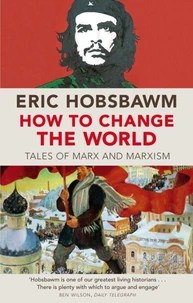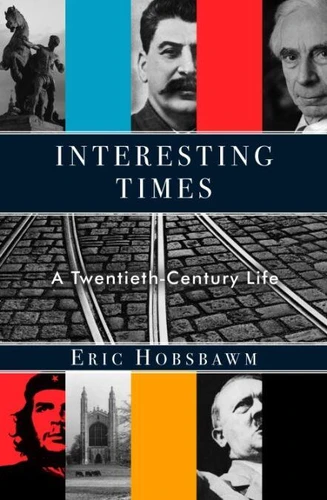
Interesting Times. A Twentieth-Century Life
Par :Formats :
Disponible dans votre compte client Decitre ou Furet du Nord dès validation de votre commande. Le format ePub protégé est :
- Compatible avec une lecture sur My Vivlio (smartphone, tablette, ordinateur)
- Compatible avec une lecture sur liseuses Vivlio
- Pour les liseuses autres que Vivlio, vous devez utiliser le logiciel Adobe Digital Edition. Non compatible avec la lecture sur les liseuses Kindle, Remarkable et Sony
- Non compatible avec un achat hors France métropolitaine
 , qui est-ce ?
Notre partenaire de plateforme de lecture numérique où vous retrouverez l'ensemble de vos ebooks gratuitement
Pour en savoir plus sur nos ebooks, consultez notre aide en ligne ici
C'est si simple ! Lisez votre ebook avec l'app Vivlio sur votre tablette, mobile ou ordinateur :

- Nombre de pages464
- FormatePub
- ISBN978-0-307-42641-3
- EAN9780307426413
- Date de parution18/12/2007
- Protection num.Adobe DRM
- Taille5 Mo
- Infos supplémentairesepub
- ÉditeurPantheon
Résumé
Eric Hobsbawm is considered by many to be our greatest living historian. Robert Heilbroner, writing about Hobsbawm's The Age of Extremes 1914-1991 said, "I know of no other account that sheds as much light on what is now behind us, and thereby casts so much illumination on our possible futures." Skeptical, endlessly curious, and almost contemporary with the terrible "short century" which is the subject of Age of Extremes, his most widely read book, Hobsbawm has, for eighty-five years, been committed to understanding the "interesting times" through which he has lived.
Hitler came to power as Hobsbawm was on his way home from school in Berlin, and the Soviet Union fell while he was giving a seminar in New York. He was a member of the Apostles at King's College, Cambridge, took E. M. Forster to hear Lenny Bruce, and demonstrated with Bertrand Russell against nuclear arms in Trafalgar Square. He translated for Che Guevara in Havana, had Christmas dinner with a Soviet master spy in Budapest and an evening at home with Mahalia Jackson in Chicago.
He saw the body of Stalin, started the modern history of banditry and is probably the only Marxist asked to collaborate with the inventor of the Mars bar. Hobsbawm takes us from Britain to the countries and cultures of Europe, to America (which he appreciated first through movies and jazz), to Latin America, Chile, India and the Far East. With Interesting Times, we see the history of the twentieth century through the unforgiving eye of one of its most intensely engaged participants, the incisiveness of whose views we cannot afford to ignore in a world in which history has come to be increasingly forgotten.
Hitler came to power as Hobsbawm was on his way home from school in Berlin, and the Soviet Union fell while he was giving a seminar in New York. He was a member of the Apostles at King's College, Cambridge, took E. M. Forster to hear Lenny Bruce, and demonstrated with Bertrand Russell against nuclear arms in Trafalgar Square. He translated for Che Guevara in Havana, had Christmas dinner with a Soviet master spy in Budapest and an evening at home with Mahalia Jackson in Chicago.
He saw the body of Stalin, started the modern history of banditry and is probably the only Marxist asked to collaborate with the inventor of the Mars bar. Hobsbawm takes us from Britain to the countries and cultures of Europe, to America (which he appreciated first through movies and jazz), to Latin America, Chile, India and the Far East. With Interesting Times, we see the history of the twentieth century through the unforgiving eye of one of its most intensely engaged participants, the incisiveness of whose views we cannot afford to ignore in a world in which history has come to be increasingly forgotten.
A propos de Eric Hobsbawm

Les bandits
Grand Format
13,10 €

12,00 €
4,80 €
On Nationalism
E-book
3,99 €
Primitive Rebels
E-book
3,99 €
3,99 €
Worlds of Labour
E-book
3,99 €
Revolutionaries
E-book
3,99 €
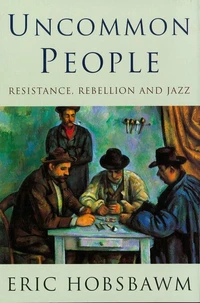
Uncommon People
E-book
3,99 €
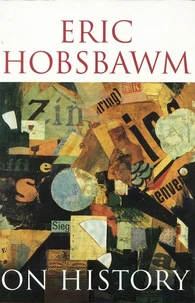
On History
E-book
3,99 €