
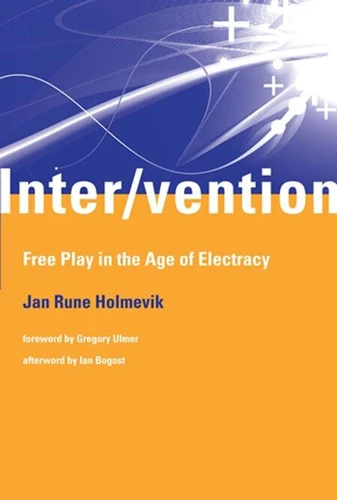
Inter/vention. Free Play in the Age of Electracy
Par : ,Formats :
Disponible dans votre compte client Decitre ou Furet du Nord dès validation de votre commande. Le format ePub protégé est :
- Compatible avec une lecture sur My Vivlio (smartphone, tablette, ordinateur)
- Compatible avec une lecture sur liseuses Vivlio
- Pour les liseuses autres que Vivlio, vous devez utiliser le logiciel Adobe Digital Edition. Non compatible avec la lecture sur les liseuses Kindle, Remarkable et Sony
- Non compatible avec un achat hors France métropolitaine
 , qui est-ce ?
Notre partenaire de plateforme de lecture numérique où vous retrouverez l'ensemble de vos ebooks gratuitement
Pour en savoir plus sur nos ebooks, consultez notre aide en ligne ici
C'est si simple ! Lisez votre ebook avec l'app Vivlio sur votre tablette, mobile ou ordinateur :

- Nombre de pages232
- FormatePub
- ISBN978-0-262-30090-2
- EAN9780262300902
- Date de parution23/03/2012
- Protection num.Adobe DRM
- Taille1010 Ko
- Infos supplémentairesepub
- ÉditeurThe MIT Press
Résumé
A proposal that electracy-the special skills needed to navigate and understand our digital world-can be developed through play. In today's complex digital world, we must understand new media expressions and digital experiences not simply as more technologically advanced forms of "writing" that can be understood and analyzed as "texts" but as artifacts in their own right that require a unique skill set.
Just as agents seeking to express themselves in alphabetic writing need to be literate, "egents" who seek to express themselves in digital media need to be-to use a term coined by cybertheorist Gregory Ulmer-electrate. In Inter/vention, Jan Holmevik helps to invent electracy. He does so by tracing its path across the digital and rhetorical landscape-informatics, hacker heuretics, ethics, pedagogy, virtual space, and monumentality-and by introducing play as a new genre of electracy.
Play, he argues, is the electrate ludic transversal. Holmevik contributes to the repertoire of electrate practices in order to understand and demonstrate how play invents electracy. Holmevik's argument straddles two divergences: in rhetoric, between how we study rhetoric as play and how we play rhetorically; and in game studies, between ludology and narratology. Games studies has forged ludology practice by distinguishing it from literate practice (and often allying itself with the scientific tradition).
Holmevik is able to link ludology and rhetoric through electracy. Play can and does facilitate invention: play invented the field of ludology. Holmevik proposes a new heuretic in which play acts as a conductor for the invention of electracy. Play is a meta behavior that touches on every aspect of Ulmer's concept of electracy.
Just as agents seeking to express themselves in alphabetic writing need to be literate, "egents" who seek to express themselves in digital media need to be-to use a term coined by cybertheorist Gregory Ulmer-electrate. In Inter/vention, Jan Holmevik helps to invent electracy. He does so by tracing its path across the digital and rhetorical landscape-informatics, hacker heuretics, ethics, pedagogy, virtual space, and monumentality-and by introducing play as a new genre of electracy.
Play, he argues, is the electrate ludic transversal. Holmevik contributes to the repertoire of electrate practices in order to understand and demonstrate how play invents electracy. Holmevik's argument straddles two divergences: in rhetoric, between how we study rhetoric as play and how we play rhetorically; and in game studies, between ludology and narratology. Games studies has forged ludology practice by distinguishing it from literate practice (and often allying itself with the scientific tradition).
Holmevik is able to link ludology and rhetoric through electracy. Play can and does facilitate invention: play invented the field of ludology. Holmevik proposes a new heuretic in which play acts as a conductor for the invention of electracy. Play is a meta behavior that touches on every aspect of Ulmer's concept of electracy.