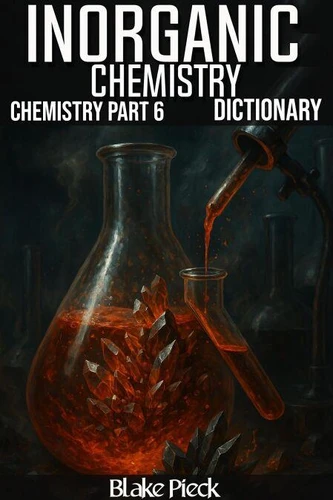
Inorganic Chemistry - Chemistry Part 6 Dictionary. Grow Your Vocabulary
Par :Formats :
Disponible dans votre compte client Decitre ou Furet du Nord dès validation de votre commande. Le format ePub est :
- Compatible avec une lecture sur My Vivlio (smartphone, tablette, ordinateur)
- Compatible avec une lecture sur liseuses Vivlio
- Pour les liseuses autres que Vivlio, vous devez utiliser le logiciel Adobe Digital Edition. Non compatible avec la lecture sur les liseuses Kindle, Remarkable et Sony
 , qui est-ce ?
Notre partenaire de plateforme de lecture numérique où vous retrouverez l'ensemble de vos ebooks gratuitement
Pour en savoir plus sur nos ebooks, consultez notre aide en ligne ici
C'est si simple ! Lisez votre ebook avec l'app Vivlio sur votre tablette, mobile ou ordinateur :

- FormatePub
- ISBN8231194186
- EAN9798231194186
- Date de parution01/09/2025
- Protection num.pas de protection
- Infos supplémentairesepub
- ÉditeurWalzone Press
Résumé
Inorganic chemistry explores the elements and compounds that form the majority of the Earth's crust, atmosphere, and core. It studies metals, minerals, salts, and coordination complexes, as well as the structures and reactivities that make them essential in both nature and technology. From catalysts that drive industrial production to materials used in energy storage and electronics, inorganic chemistry demonstrates the versatility of elements beyond carbon.
Within the wider context of chemistry, this field provides a framework for understanding the periodic table as a system of patterns and predictions. Inorganic study links atomic structure with practical applications, showing how bonding, symmetry, and electronic configuration influence the behavior of matter. Its principles connect directly with solid-state chemistry, geochemistry, and materials science, broadening the reach of chemical knowledge.
This dictionary gathers the language of inorganic chemistry into clear and detailed entries. Readers will find explanations of coordination compounds, transition metals, crystal field theory, and molecular geometry, alongside the terminology of reactions and processes central to the field. Designed for accessibility, it supports students in study, assists teachers in instruction, and provides researchers with a reliable point of reference.
Structured learning through a dictionary builds command over terminology and enhances the ability to recognize patterns across chemical systems. By revisiting definitions and connecting related concepts, readers gain stronger foundations for both theory and application. Inorganic chemistry's scope makes it indispensable to science and industry, and mastering its vocabulary is an enduring step toward deeper understanding and professional growth.
Within the wider context of chemistry, this field provides a framework for understanding the periodic table as a system of patterns and predictions. Inorganic study links atomic structure with practical applications, showing how bonding, symmetry, and electronic configuration influence the behavior of matter. Its principles connect directly with solid-state chemistry, geochemistry, and materials science, broadening the reach of chemical knowledge.
This dictionary gathers the language of inorganic chemistry into clear and detailed entries. Readers will find explanations of coordination compounds, transition metals, crystal field theory, and molecular geometry, alongside the terminology of reactions and processes central to the field. Designed for accessibility, it supports students in study, assists teachers in instruction, and provides researchers with a reliable point of reference.
Structured learning through a dictionary builds command over terminology and enhances the ability to recognize patterns across chemical systems. By revisiting definitions and connecting related concepts, readers gain stronger foundations for both theory and application. Inorganic chemistry's scope makes it indispensable to science and industry, and mastering its vocabulary is an enduring step toward deeper understanding and professional growth.
Inorganic chemistry explores the elements and compounds that form the majority of the Earth's crust, atmosphere, and core. It studies metals, minerals, salts, and coordination complexes, as well as the structures and reactivities that make them essential in both nature and technology. From catalysts that drive industrial production to materials used in energy storage and electronics, inorganic chemistry demonstrates the versatility of elements beyond carbon.
Within the wider context of chemistry, this field provides a framework for understanding the periodic table as a system of patterns and predictions. Inorganic study links atomic structure with practical applications, showing how bonding, symmetry, and electronic configuration influence the behavior of matter. Its principles connect directly with solid-state chemistry, geochemistry, and materials science, broadening the reach of chemical knowledge.
This dictionary gathers the language of inorganic chemistry into clear and detailed entries. Readers will find explanations of coordination compounds, transition metals, crystal field theory, and molecular geometry, alongside the terminology of reactions and processes central to the field. Designed for accessibility, it supports students in study, assists teachers in instruction, and provides researchers with a reliable point of reference.
Structured learning through a dictionary builds command over terminology and enhances the ability to recognize patterns across chemical systems. By revisiting definitions and connecting related concepts, readers gain stronger foundations for both theory and application. Inorganic chemistry's scope makes it indispensable to science and industry, and mastering its vocabulary is an enduring step toward deeper understanding and professional growth.
Within the wider context of chemistry, this field provides a framework for understanding the periodic table as a system of patterns and predictions. Inorganic study links atomic structure with practical applications, showing how bonding, symmetry, and electronic configuration influence the behavior of matter. Its principles connect directly with solid-state chemistry, geochemistry, and materials science, broadening the reach of chemical knowledge.
This dictionary gathers the language of inorganic chemistry into clear and detailed entries. Readers will find explanations of coordination compounds, transition metals, crystal field theory, and molecular geometry, alongside the terminology of reactions and processes central to the field. Designed for accessibility, it supports students in study, assists teachers in instruction, and provides researchers with a reliable point of reference.
Structured learning through a dictionary builds command over terminology and enhances the ability to recognize patterns across chemical systems. By revisiting definitions and connecting related concepts, readers gain stronger foundations for both theory and application. Inorganic chemistry's scope makes it indispensable to science and industry, and mastering its vocabulary is an enduring step toward deeper understanding and professional growth.