
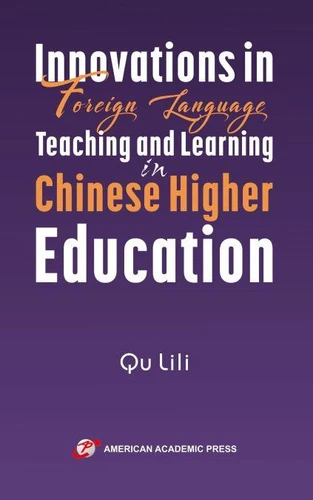
Innovations in Foreign Language Teaching and Learning in Chinese Higher Education
Par :Formats :
Disponible dans votre compte client Decitre ou Furet du Nord dès validation de votre commande. Le format ePub est :
- Compatible avec une lecture sur My Vivlio (smartphone, tablette, ordinateur)
- Compatible avec une lecture sur liseuses Vivlio
- Pour les liseuses autres que Vivlio, vous devez utiliser le logiciel Adobe Digital Edition. Non compatible avec la lecture sur les liseuses Kindle, Remarkable et Sony
 , qui est-ce ?
Notre partenaire de plateforme de lecture numérique où vous retrouverez l'ensemble de vos ebooks gratuitement
Pour en savoir plus sur nos ebooks, consultez notre aide en ligne ici
C'est si simple ! Lisez votre ebook avec l'app Vivlio sur votre tablette, mobile ou ordinateur :

- FormatePub
- ISBN8230316510
- EAN9798230316510
- Date de parution18/11/2024
- Protection num.pas de protection
- Infos supplémentairesepub
- ÉditeurIndependently Published
Résumé
The book reviews recent theoretical and pedagogical innovations in foreign language teaching and learning in Chinese higher education. Facing new requirements of foreign language education, Chinese researchers and practitioners have responded by developing innovative teaching and learning approaches suitable for the local context. Firstly, Xu-argument and Production-Oriented Approach are theories proposed to address the weaknesses of low teaching efficiency and meet the needs for better learning effect.
The former is a new approach to second language acquisition, contending that language is acquired through continuation, and the latter is a pedagogical theory that holds that learning starts with and ends with production. As an innovative teaching approach, Content and Language Integration (CLI) expands the curriculum to incorporate systematic disciplinary knowledge into foreign language teaching in the Chinese context.
In modern media technology, multimodal pedagogy has been adopted to cultivate multiliteracies in language learners as new requirements for talents. In addition, Chinese scholars have argued for the comprehensive integration of technologies and have engaged in theoretical construction and pedagogical practice of technology-enhanced language teaching. Finally, projected-based language learning has been localized to foster innovation and creativity in English learners.
The former is a new approach to second language acquisition, contending that language is acquired through continuation, and the latter is a pedagogical theory that holds that learning starts with and ends with production. As an innovative teaching approach, Content and Language Integration (CLI) expands the curriculum to incorporate systematic disciplinary knowledge into foreign language teaching in the Chinese context.
In modern media technology, multimodal pedagogy has been adopted to cultivate multiliteracies in language learners as new requirements for talents. In addition, Chinese scholars have argued for the comprehensive integration of technologies and have engaged in theoretical construction and pedagogical practice of technology-enhanced language teaching. Finally, projected-based language learning has been localized to foster innovation and creativity in English learners.