
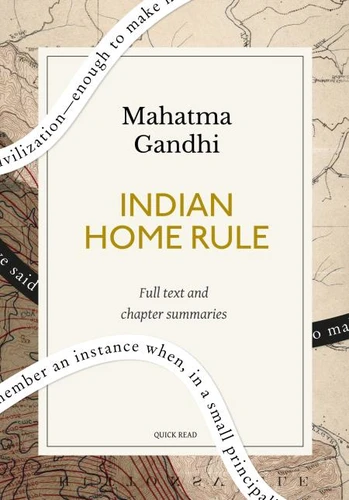
Indian Home Rule: A Quick Read edition
Par : ,Formats :
Disponible dans votre compte client Decitre ou Furet du Nord dès validation de votre commande. Le format Multi-format est :
- Pour les liseuses autres que Vivlio, vous devez utiliser le logiciel Adobe Digital Edition. Non compatible avec la lecture sur les liseuses Kindle, Remarkable et Sony
 , qui est-ce ?
Notre partenaire de plateforme de lecture numérique où vous retrouverez l'ensemble de vos ebooks gratuitement
Pour en savoir plus sur nos ebooks, consultez notre aide en ligne ici
C'est si simple ! Lisez votre ebook avec l'app Vivlio sur votre tablette, mobile ou ordinateur :

- FormatMulti-format
- ISBN978-2-38582-110-4
- EAN9782385821104
- Date de parution16/02/2024
- Protection num.pas de protection
- Infos supplémentairesMulti-Format
- ÉditeurQuick Read
Résumé
Discover a new way to read classics with Quick Read.
This Quick Read edition includes both the full text and a summary for each chapter.
- Reading time of the complete text: about 2 hours
- Reading time of the summarized text: 17 minutes
"Hind Swaraj or Indian Home Rule" is a book written by Mohandas K. Gandhi in 1909. In this book, Gandhi expresses his views on Swaraj (self-rule), modern civilization, and mechanization.
He criticizes European civilization while expressing loyalty to higher ideals of empire. The book was banned by the British government in India in 1910 as a seditious text. The book takes the form of a dialogue between two characters, The Reader and The Editor, where Gandhi refutes common arguments for Indian Independence and presents his own arguments. Gandhi argues that Home Rule is Self Rule and that Indian independence can only be achieved through passive resistance.
He advocates for Swadeshi, the refusal of all trade and dealings with the British, as a means of exerting passive resistance. Gandhi also argues that India will never be free unless it rejects Western civilization itself. The book received varied responses from notable writers. The Gujarati version of the book was banned by the British authorities upon its publication in India.
He criticizes European civilization while expressing loyalty to higher ideals of empire. The book was banned by the British government in India in 1910 as a seditious text. The book takes the form of a dialogue between two characters, The Reader and The Editor, where Gandhi refutes common arguments for Indian Independence and presents his own arguments. Gandhi argues that Home Rule is Self Rule and that Indian independence can only be achieved through passive resistance.
He advocates for Swadeshi, the refusal of all trade and dealings with the British, as a means of exerting passive resistance. Gandhi also argues that India will never be free unless it rejects Western civilization itself. The book received varied responses from notable writers. The Gujarati version of the book was banned by the British authorities upon its publication in India.
A propos de Quick Read


4,99 €
4,99 €
4,99 €
4,99 €
4,99 €
4,99 €
4,99 €

4,99 €

4,99 €

4,99 €

4,99 €

4,99 €

4,99 €

4,99 €

4,99 €