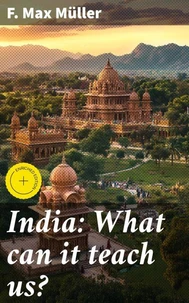
In "India: What Can It Teach Us?", F. Max Müller embarks on a profound exploration of Indian philosophy, culture, and spirituality, arguing for the richness and depth of India's contributions to global thought. The book is characterized by Müller's elegant prose and scholarly rigor, as he juxtaposes Western paradigms with Eastern wisdom, illustrating how Indian thought can illuminate issues of morality, ethics, and the nature of existence.
Throughout the text, Müller employs a comparative literary style that entertains while educating, inviting readers to reconsider the philosophical foundations of their own beliefs in the context of Indian traditions like Vedanta and Buddhism. Friedrich Max Müller was a pioneering philologist and indologist, renowned for his work in translating and interpreting ancient Indian texts. His deep engagement with Sanskrit literature and his formative experiences in both Germany and India shaped his understanding of the intricate relationship between language, culture, and spirituality.
Müller's passion for fostering cross-cultural dialogue and his belief in the transformative power of Indian wisdom led him to compile this work, aiming to bridge the East and West intellectually and ethically. This book is a must-read for scholars of comparative religion, philosophy, and anyone interested in the intersection of Eastern and Western thought. Müller's insightful observations provide not only an understanding of India's spiritual depth but also a call for introspection and integration of these lessons into contemporary life.
Readers will find themselves challenged and enriched by the ideas presented, making it a vital addition to any library.
In "India: What Can It Teach Us?", F. Max Müller embarks on a profound exploration of Indian philosophy, culture, and spirituality, arguing for the richness and depth of India's contributions to global thought. The book is characterized by Müller's elegant prose and scholarly rigor, as he juxtaposes Western paradigms with Eastern wisdom, illustrating how Indian thought can illuminate issues of morality, ethics, and the nature of existence.
Throughout the text, Müller employs a comparative literary style that entertains while educating, inviting readers to reconsider the philosophical foundations of their own beliefs in the context of Indian traditions like Vedanta and Buddhism. Friedrich Max Müller was a pioneering philologist and indologist, renowned for his work in translating and interpreting ancient Indian texts. His deep engagement with Sanskrit literature and his formative experiences in both Germany and India shaped his understanding of the intricate relationship between language, culture, and spirituality.
Müller's passion for fostering cross-cultural dialogue and his belief in the transformative power of Indian wisdom led him to compile this work, aiming to bridge the East and West intellectually and ethically. This book is a must-read for scholars of comparative religion, philosophy, and anyone interested in the intersection of Eastern and Western thought. Müller's insightful observations provide not only an understanding of India's spiritual depth but also a call for introspection and integration of these lessons into contemporary life.
Readers will find themselves challenged and enriched by the ideas presented, making it a vital addition to any library.
 , qui est-ce ?