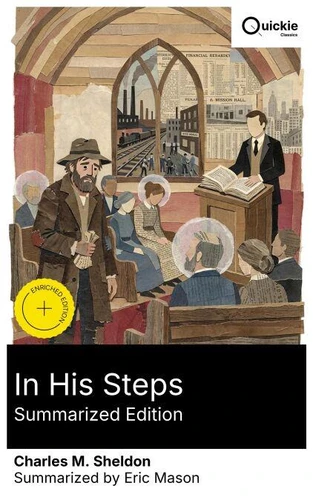
In His Steps (1896) dramatizes the question "What Would Jesus Do?" When a destitute stranger confronts complacent parishioners in Raymond, Rev. Henry Maxwell calls them to vow for a year to test every decision by Jesus' example. Through linked episodes-from a star singer's sacrifice to a newspaper's ethical overhaul and urban mission-the novel blends didactic narrative and Social Gospel critique of Gilded Age capitalism and labor.
Its episodic form, pulpit-toned narration, and stress on communal discipleship align it with reform fiction of the Progressive Era. Sheldon, a Congregational minister in Topeka, Kansas, wrote from pastoral experience among the poor and from experiments in applying Christian ethics to journalism (famously editing a daily paper under Christian principles). Steeped in revivalist rhetoric and the emerging Social Gospel, he sought to move religion from private piety to public ethics, crafting fiction as a sermon in action.
Readers of religious history, ethics, and American literature will find in this novel a lucid primer on the Social Gospel's demands and possibilities. It is recommended for book groups, clergy, reform-minded professionals, and skeptics alike, for its simple prose conceals a provocative program: an invitation to audit one's life-budgets, ballots, and business-by the standard of discipleship.
Quickie Classics summarizes timeless works with precision, preserving the author's voice and keeping the prose clear, fast, and readable-distilled, never diluted.
Enriched Edition extras: Introduction · Synopsis · Historical Context · Brief Analysis · 4 Reflection Q&As · Editorial Footnotes.
In His Steps (1896) dramatizes the question "What Would Jesus Do?" When a destitute stranger confronts complacent parishioners in Raymond, Rev. Henry Maxwell calls them to vow for a year to test every decision by Jesus' example. Through linked episodes-from a star singer's sacrifice to a newspaper's ethical overhaul and urban mission-the novel blends didactic narrative and Social Gospel critique of Gilded Age capitalism and labor.
Its episodic form, pulpit-toned narration, and stress on communal discipleship align it with reform fiction of the Progressive Era. Sheldon, a Congregational minister in Topeka, Kansas, wrote from pastoral experience among the poor and from experiments in applying Christian ethics to journalism (famously editing a daily paper under Christian principles). Steeped in revivalist rhetoric and the emerging Social Gospel, he sought to move religion from private piety to public ethics, crafting fiction as a sermon in action.
Readers of religious history, ethics, and American literature will find in this novel a lucid primer on the Social Gospel's demands and possibilities. It is recommended for book groups, clergy, reform-minded professionals, and skeptics alike, for its simple prose conceals a provocative program: an invitation to audit one's life-budgets, ballots, and business-by the standard of discipleship.
Quickie Classics summarizes timeless works with precision, preserving the author's voice and keeping the prose clear, fast, and readable-distilled, never diluted.
Enriched Edition extras: Introduction · Synopsis · Historical Context · Brief Analysis · 4 Reflection Q&As · Editorial Footnotes.

 , qui est-ce ?