
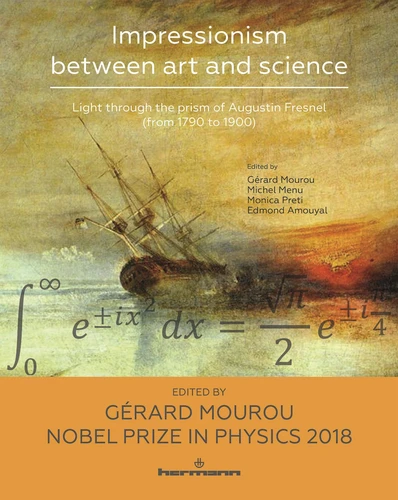
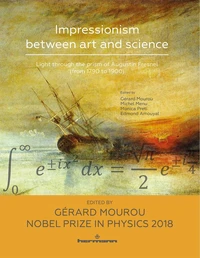
Impressionism between art and science. Light through the prism of Augustin Fresnel (from 1790 to 1900)
Par : , , ,Formats :
Disponible dans votre compte client Decitre ou Furet du Nord dès validation de votre commande. Le format PDF protégé est :
- Compatible avec une lecture sur My Vivlio (smartphone, tablette, ordinateur)
- Compatible avec une lecture sur liseuses Vivlio
- Pour les liseuses autres que Vivlio, vous devez utiliser le logiciel Adobe Digital Edition. Non compatible avec la lecture sur les liseuses Kindle, Remarkable et Sony
- Non compatible avec un achat hors France métropolitaine
 , qui est-ce ?
Notre partenaire de plateforme de lecture numérique où vous retrouverez l'ensemble de vos ebooks gratuitement
Pour en savoir plus sur nos ebooks, consultez notre aide en ligne ici
C'est si simple ! Lisez votre ebook avec l'app Vivlio sur votre tablette, mobile ou ordinateur :

- Nombre de pages400
- FormatPDF
- ISBN979-10-370-3732-9
- EAN9791037037329
- Date de parution04/11/2020
- Protection num.Adobe DRM
- Taille127 Mo
- Infos supplémentairespdf
- ÉditeurHermann
Résumé
1820. Painting was undergoing a profound transformation. Representations of reality no longer took precedence over colour. Details were becoming less important and, above all, light began to vibrate, achieving predominance, and announcing Impressionism. In the scientific field, Augustin Fresnel, a young graduate from the Ecole Polytechnique, demonstrated, with the help of his friends André-Marie Ampère and François Arago, that light was made up of waves rather than particles, a theory that ran counter to Newton and all the scientists of the time.
The fact that these scientific and pictorial revolutions occurred at the same time - a phenomenon that, to our knowledge, has never previously been explored by art historians - is troubling.
Through the prism of Augustin Fresnel, we find many fascinating examples of the wave character of light in Impressionist painting, the master of which was Monet. Aspects of undulation and diffraction stand out. But how can we explain the fifty year period separating the discovery of the wave-like nature of light and the port of Le Havre depicted in Monet's Impression, Sunrise (1872), considered the first Impressionist painting ? We attempted to reply to this question by gathering together art historians, artists and physicists at a conference organised by the Louvre and the Ecole Polytechnique, two establishments founded during the French Revolution.
Through the prism of Augustin Fresnel, we find many fascinating examples of the wave character of light in Impressionist painting, the master of which was Monet. Aspects of undulation and diffraction stand out. But how can we explain the fifty year period separating the discovery of the wave-like nature of light and the port of Le Havre depicted in Monet's Impression, Sunrise (1872), considered the first Impressionist painting ? We attempted to reply to this question by gathering together art historians, artists and physicists at a conference organised by the Louvre and the Ecole Polytechnique, two establishments founded during the French Revolution.
A propos de Michel Menu
8,49 €
Piste 23
E-book
7,99 €
35,00 €
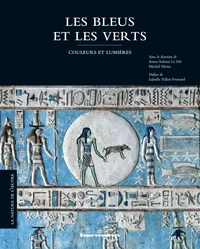
Les bleus et les verts. Couleurs et lumières
Grand Format
35,00 €
20,00 €
19,00 €
20,00 €