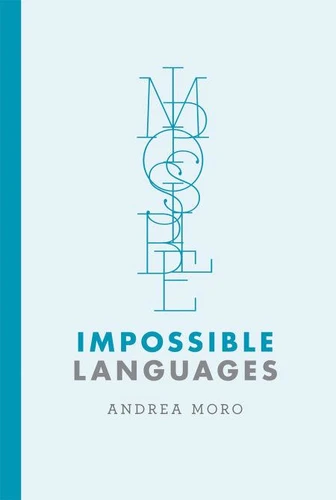
Impossible Languages
Par :Formats :
Disponible dans votre compte client Decitre ou Furet du Nord dès validation de votre commande. Le format ePub protégé est :
- Compatible avec une lecture sur My Vivlio (smartphone, tablette, ordinateur)
- Compatible avec une lecture sur liseuses Vivlio
- Pour les liseuses autres que Vivlio, vous devez utiliser le logiciel Adobe Digital Edition. Non compatible avec la lecture sur les liseuses Kindle, Remarkable et Sony
- Non compatible avec un achat hors France métropolitaine
 , qui est-ce ?
Notre partenaire de plateforme de lecture numérique où vous retrouverez l'ensemble de vos ebooks gratuitement
Pour en savoir plus sur nos ebooks, consultez notre aide en ligne ici
C'est si simple ! Lisez votre ebook avec l'app Vivlio sur votre tablette, mobile ou ordinateur :

- Nombre de pages160
- FormatePub
- ISBN978-0-262-33561-4
- EAN9780262335614
- Date de parution26/08/2016
- Protection num.Adobe DRM
- Taille304 Ko
- Infos supplémentairesepub
- ÉditeurThe MIT Press
Résumé
An investigation into the possibility of impossible languages, searching for the indelible "fingerprint" of human language. Can there be such a thing as an impossible human language? A biologist could describe an impossible animal as one that goes against the physical laws of nature (entropy, for example, or gravity). Are there any such laws that constrain languages? In this book, Andrea Moro-a distinguished linguist and neuroscientist-investigates the possibility of impossible languages, searching, as he does so, for the indelible "fingerprint" of human language.
Moro shows how the very notion of impossible languages has helped shape research on the ultimate aim of linguistics: to define the class of possible human languages. He takes us beyond the boundaries of Babel, to the set of properties that, despite appearances, all languages share, and explores the sources of that order, drawing on scientific experiments he himself helped design. Moro compares syntax to the reverse side of a tapestry revealing a hidden and apparently intricate structure.
He describes the brain as a sieve, considers the reality of (linguistic) trees, and listens for the sound of thought by recording electrical activity in the brain. Words and sentences, he tells us, are like symphonies and constellations: they have no content of their own; they exist because we listen to them and look at them. We are part of the data.
Moro shows how the very notion of impossible languages has helped shape research on the ultimate aim of linguistics: to define the class of possible human languages. He takes us beyond the boundaries of Babel, to the set of properties that, despite appearances, all languages share, and explores the sources of that order, drawing on scientific experiments he himself helped design. Moro compares syntax to the reverse side of a tapestry revealing a hidden and apparently intricate structure.
He describes the brain as a sieve, considers the reality of (linguistic) trees, and listens for the sound of thought by recording electrical activity in the brain. Words and sentences, he tells us, are like symphonies and constellations: they have no content of their own; they exist because we listen to them and look at them. We are part of the data.