
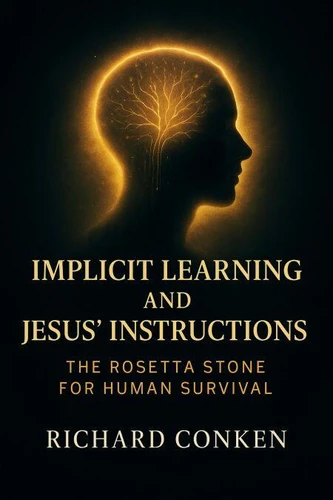
Implicit Learning and Jesus' Instructions: the rosetta stone for human survival. saving our species initiative, #1
Par :Formats :
Disponible dans votre compte client Decitre ou Furet du Nord dès validation de votre commande. Le format ePub est :
- Compatible avec une lecture sur My Vivlio (smartphone, tablette, ordinateur)
- Compatible avec une lecture sur liseuses Vivlio
- Pour les liseuses autres que Vivlio, vous devez utiliser le logiciel Adobe Digital Edition. Non compatible avec la lecture sur les liseuses Kindle, Remarkable et Sony
 , qui est-ce ?
Notre partenaire de plateforme de lecture numérique où vous retrouverez l'ensemble de vos ebooks gratuitement
Pour en savoir plus sur nos ebooks, consultez notre aide en ligne ici
C'est si simple ! Lisez votre ebook avec l'app Vivlio sur votre tablette, mobile ou ordinateur :

- FormatePub
- ISBN8232873844
- EAN9798232873844
- Date de parution05/11/2025
- Protection num.pas de protection
- Infos supplémentairesepub
- ÉditeurDraft2Digital
Résumé
This book reexamines Jesus' teachings as a universal and empirically grounded pathway for human development. Modern research into implicit learning-the automatic, unconscious absorption of relational patterns-reveals that much of human suffering is not caused by deliberate choice, but by inherited emotional reflexes and social scripts passed through families, communities, and culture. These internalized patterns form the engine of continuous human suffering, silently shaping behavior and limiting our capacity for trust, cooperation, and compassion.
Within this framework, Jesus' teachings emerge not merely as moral ideals, but as targeted interventions designed to retrain implicit learning systems. Commands such as forgiving offenses, telling the truth even when uncomfortable, acting with generosity, and responding to fear with courage function as structured practices that reshape instinctive responses over time. They are not abstract virtues; they are mechanisms for re-patterning the human nervous system toward relational safety, emotional maturity, and cooperative strength.
This approach avoids denominational boundaries and metaphysical assertions, instead focusing on observable transformation. Salvation is reframed as developmental repair, spiritual growth as the progressive refinement of relational instincts, and the "Kingdom of God" as a lived social condition emerging wherever these principles are practiced. The result is a framework in which faith is not defined by belief alone, but by participation in processes that produce measurable human flourishing.
By applying these teachings within households, communities, and shared practice environments, readers can engage a practical and testable model for human healing-one capable of interrupting inherited dysfunction and cultivating a stable foundation for future generations. Jesus' message, viewed through the lens of implicit learning, becomes a blueprint for a cooperative human species and a compelling path toward sustainable harmony.
Within this framework, Jesus' teachings emerge not merely as moral ideals, but as targeted interventions designed to retrain implicit learning systems. Commands such as forgiving offenses, telling the truth even when uncomfortable, acting with generosity, and responding to fear with courage function as structured practices that reshape instinctive responses over time. They are not abstract virtues; they are mechanisms for re-patterning the human nervous system toward relational safety, emotional maturity, and cooperative strength.
This approach avoids denominational boundaries and metaphysical assertions, instead focusing on observable transformation. Salvation is reframed as developmental repair, spiritual growth as the progressive refinement of relational instincts, and the "Kingdom of God" as a lived social condition emerging wherever these principles are practiced. The result is a framework in which faith is not defined by belief alone, but by participation in processes that produce measurable human flourishing.
By applying these teachings within households, communities, and shared practice environments, readers can engage a practical and testable model for human healing-one capable of interrupting inherited dysfunction and cultivating a stable foundation for future generations. Jesus' message, viewed through the lens of implicit learning, becomes a blueprint for a cooperative human species and a compelling path toward sustainable harmony.