
Krzysztof Mielcarek is associate professor at the Katholic University of Lublin and a head of the Department of Exegesis of the Gospels and Apostolic Writings.
Adam Kubis is Professor at the Faculty of Theology / Institute of Biblical Studies at the John Paul II Catholic University of Lublin.
Marek Jagodzinski, Prof. Dr. hab., is Professor in the Chair of the Orthodox Theology at the Faculty of Theology, The John Paul II Catholic University of Lublin, Poland, and Major Seminary in Radom, Poland.
Pawel Makosa is Professor of Theology specializing in religious education, with research focusing on the effectiveness of religious instruction in schools and the challenges posed by youth secularization.
Pawel Makosa is Professor of Theology specializing in religious education, with research focusing on the effectiveness of religious instruction in schools and the challenges posed by youth secularization.
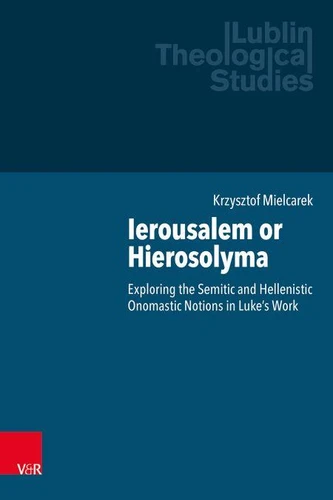
Ierousalem or Hierosolyma. Exploring the Semitic and Hellenistic Onomastic Notions in Luke's Work
Par : , , , ,Formats :
Disponible dans votre compte client Decitre ou Furet du Nord dès validation de votre commande. Le format PDF est :
- Compatible avec une lecture sur My Vivlio (smartphone, tablette, ordinateur)
- Compatible avec une lecture sur liseuses Vivlio
- Pour les liseuses autres que Vivlio, vous devez utiliser le logiciel Adobe Digital Edition. Non compatible avec la lecture sur les liseuses Kindle, Remarkable et Sony
 , qui est-ce ?
Notre partenaire de plateforme de lecture numérique où vous retrouverez l'ensemble de vos ebooks gratuitement
Pour en savoir plus sur nos ebooks, consultez notre aide en ligne ici
C'est si simple ! Lisez votre ebook avec l'app Vivlio sur votre tablette, mobile ou ordinateur :

- Nombre de pages288
- FormatPDF
- ISBN978-3-647-50042-3
- EAN9783647500423
- Date de parution04/12/2023
- Protection num.pas de protection
- Taille3 Mo
- Infos supplémentairespdf
- ÉditeurVandenhoeck & Ruprecht
Résumé
There is no doubt that Jerusalem in the Bible is a city of great historical and theological significance. However, many modern readers are unaware that authors writing in Greek used its two names, Ierousalem and Heriosolyma. Among the few who used both names simultaneously is Luke the Evangelist. Commentators of this onomastic phenomenon have tried to explain this fact in various ways, referring to Luke's literary and theological choices or denying its meaning altogether.
Krzysztof Mielcarek's monograph proposes a new view and explanation of this phenomenon in a theological-historical key. In his opinion, Luke's choices may be underpinned by his deep immersion in the world and terminological richness of the Septuagint, as well as important historical events that influenced the perception of the Holy City by the Hellenistic Jewish community and later also by the early Christians.
Krzysztof Mielcarek's monograph proposes a new view and explanation of this phenomenon in a theological-historical key. In his opinion, Luke's choices may be underpinned by his deep immersion in the world and terminological richness of the Septuagint, as well as important historical events that influenced the perception of the Holy City by the Hellenistic Jewish community and later also by the early Christians.