SOLDES
Jusqu'à -70% sur une sélection d'articles*

Nouveauté
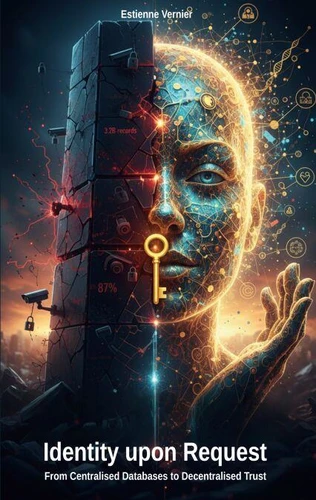
Identity Upon Request. From Centralised Databases to Decentralised Trust
Par :Formats :
Disponible dans votre compte client Decitre ou Furet du Nord dès validation de votre commande. Le format ePub est :
- Compatible avec une lecture sur My Vivlio (smartphone, tablette, ordinateur)
- Compatible avec une lecture sur liseuses Vivlio
- Pour les liseuses autres que Vivlio, vous devez utiliser le logiciel Adobe Digital Edition. Non compatible avec la lecture sur les liseuses Kindle, Remarkable et Sony
 , qui est-ce ?
Notre partenaire de plateforme de lecture numérique où vous retrouverez l'ensemble de vos ebooks gratuitement
Pour en savoir plus sur nos ebooks, consultez notre aide en ligne ici
C'est si simple ! Lisez votre ebook avec l'app Vivlio sur votre tablette, mobile ou ordinateur :

- Nombre de pages192
- FormatePub
- ISBN978-3-6963-2145-1
- EAN9783696321451
- Date de parution29/06/2026
- Protection num.pas de protection
- Taille980 Ko
- Infos supplémentairesepub
- ÉditeurBoD - Books on Demand
Résumé
Every person who holds an identity document received it the same way: by applying. By standing in line, filling out forms, and paying fees - to receive a document that says less about them than any friend could. Identity upon Request asks why.
The book makes a single, falsifiable claim: the people who already know you - your family, your doctor, your employer, your neighbours - hold more identity knowledge than any government database, and modern cryptography can make that knowledge verifiable, portable, and private without any central authority.
In the proposed system, trusted people attest to facts about your identity. These attestations are cryptographically secured on a chip card you control. When a verifier checks you - say, an age verification - the card produces a mathematical proof that the attestation exists without revealing your name, your date of birth, or who attested. No central database. No data leaks. No surveillance. Twelve chapters build the case: from the history of identity documents (parish registers to facial recognition), through a trillion-dollar economic audit of the current system, the condition of 850 million undocumented people, and the catastrophic record of identity systems turned against their own populations (Rwanda, Nazi Germany, Apartheid South Africa), to a complete technical architecture for a decentralised alternative - published under CC-BY 4.0 so anyone can build it. The book engages the strongest case for centralisation - Germany's Personal Identity Card, the World Bank's ID4D programme, the development argument for biometric databases - and shows where even the best versions fall short. With three appendices (technical architecture, economic methodology, paternalism audit), many footnotes, and a full bibliography.
For policymakers, technologists, civil society, researchers, and anyone who has ever stood in line at a government office and wondered why.
In the proposed system, trusted people attest to facts about your identity. These attestations are cryptographically secured on a chip card you control. When a verifier checks you - say, an age verification - the card produces a mathematical proof that the attestation exists without revealing your name, your date of birth, or who attested. No central database. No data leaks. No surveillance. Twelve chapters build the case: from the history of identity documents (parish registers to facial recognition), through a trillion-dollar economic audit of the current system, the condition of 850 million undocumented people, and the catastrophic record of identity systems turned against their own populations (Rwanda, Nazi Germany, Apartheid South Africa), to a complete technical architecture for a decentralised alternative - published under CC-BY 4.0 so anyone can build it. The book engages the strongest case for centralisation - Germany's Personal Identity Card, the World Bank's ID4D programme, the development argument for biometric databases - and shows where even the best versions fall short. With three appendices (technical architecture, economic methodology, paternalism audit), many footnotes, and a full bibliography.
For policymakers, technologists, civil society, researchers, and anyone who has ever stood in line at a government office and wondered why.