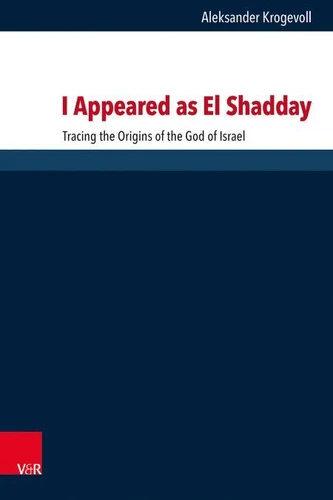



I Appeared as El Shadday. Tracing the Origins of the God of Israel

Par : Aleksander Krogevoll, Ismo Dunderberg, Jan Christian Gertz, Jennifer Knust, Hermut Löhr
Offrir maintenant
Ou planifier dans votre panier
Disponible dans votre compte client Decitre ou Furet du Nord dès validation de votre commande. Le format PDF est :
  • Compatible avec une lecture sur My Vivlio (smartphone, tablette, ordinateur)
  • Compatible avec une lecture sur liseuses Vivlio
  • Pour les liseuses autres que Vivlio, vous devez utiliser le logiciel Adobe Digital Edition. Non compatible avec la lecture sur les liseuses Kindle, Remarkable et Sony
Logo Vivlio, qui est-ce ?

Notre partenaire de plateforme de lecture numérique où vous retrouverez l'ensemble de vos ebooks gratuitement

Pour en savoir plus sur nos ebooks, consultez notre aide en ligne ici
C'est si simple ! Lisez votre ebook avec l'app Vivlio sur votre tablette, mobile ou ordinateur :
Google PlayApp Store
  • Nombre de pages223
  • FormatPDF
  • ISBN978-3-647-50227-4
  • EAN9783647502274
  • Date de parution13/10/2025
  • Protection num.pas de protection
  • Taille2 Mo
  • Infos supplémentairespdf
  • ÉditeurVandenhoeck & Ruprecht

Résumé

Aleksander Krogevoll offers the first extensive study on El Shadday. This includes the most thorough review of all etymologies proposed for Shadday and the most extensive examination on the use and meaning of Shadday in the Hebrew Bible. The author challenges the views that Shadday was unique to the Priestly source or that Priestly source invented the epithet. He supports the etymology of Shaddai being the Akkadian sadû, "mountain." By tracing the epithet sadû from Akkadian where it was attached to Enlil and Dagan to the Ugaritic El, Krogevoll presents a new hypothesis for how Shadday was introduced into Hebrew.
This work is the first book-length study on the equation between El Shadday and Yahweh. Other scholars have proposed that their shared mountain motifs played a part in the equation, but this work is the first study to examine the equation through the lens of the shared mountain motifs at length.
Aleksander Krogevoll is Associate Professor in Religion, Worldviews and Ethics at the Volda University College, Norway. Ismo Dunderberg ist Professor für Neues Testament an der Universität Helsinki. Jan Christian Gertz ist Professor für Altes Testament an der Universität Heidelberg. Jennifer Knust is Professor of Religious Studies. She specializes in early Christian history and the religions of the ancient Mediterranean. Hermut Löhr ist Professor für Neues Testament und Antikes Judentum an der Evangelisch-Theologischen Fakultät der Rheinischen Friedrich-Wilhelms-Universität Bonn. Susanne Luther is Professor of New Testament at Georg-August University Göttingen. Joachim Schaper is Professor for Old Testament and holds the position of Chair of Hebrew and Semitic Languages at the University of Aberdeen. Schaper has taught at the universities of Cambridge and Tübingen, and has served in various capacities at the University of Heidelberg, the Freie Universität Berlin, and other institutions.
He was the President of the IOSOT in the years 2016-2019 and is ordained in the Lutheran Church.