
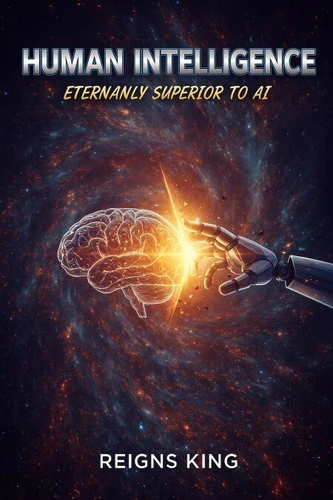
Human Intelligence: Eternally Superior to AI
Par :Formats :
Disponible dans votre compte client Decitre ou Furet du Nord dès validation de votre commande. Le format ePub est :
- Compatible avec une lecture sur My Vivlio (smartphone, tablette, ordinateur)
- Compatible avec une lecture sur liseuses Vivlio
- Pour les liseuses autres que Vivlio, vous devez utiliser le logiciel Adobe Digital Edition. Non compatible avec la lecture sur les liseuses Kindle, Remarkable et Sony
 , qui est-ce ?
Notre partenaire de plateforme de lecture numérique où vous retrouverez l'ensemble de vos ebooks gratuitement
Pour en savoir plus sur nos ebooks, consultez notre aide en ligne ici
C'est si simple ! Lisez votre ebook avec l'app Vivlio sur votre tablette, mobile ou ordinateur :

- FormatePub
- ISBN8232830755
- EAN9798232830755
- Date de parution18/11/2025
- Protection num.pas de protection
- Infos supplémentairesepub
- ÉditeurDraft2Digital
Résumé
In an age of rapid AI advancement, a fundamental question emerges: what makes human intelligence irreplaceable? This book examines five dimensions where human capabilities transcend computational power: consciousness and subjective experience, genuine creativity and intuition, moral wisdom and ethical judgment, authentic relationships and emotional depth, and our ability to shape a human-centered future.
Through rigorous philosophical analysis and practical examples, it explores why machines process information without experiencing anything, why AI generation differs from human creativity, why programmed ethics cannot replace moral wisdom, and why simulated companionship lacks the essence of genuine connection. Drawing on consciousness studies, cognitive science, and moral philosophy, this work argues that human intelligence possesses qualities computation cannot replicate.
It examines what these differences mean for education, policy, and society, offering a framework for preserving human authority in an increasingly automated world while recognizing the unchanging value of human consciousness, creativity, and wisdom.
Through rigorous philosophical analysis and practical examples, it explores why machines process information without experiencing anything, why AI generation differs from human creativity, why programmed ethics cannot replace moral wisdom, and why simulated companionship lacks the essence of genuine connection. Drawing on consciousness studies, cognitive science, and moral philosophy, this work argues that human intelligence possesses qualities computation cannot replicate.
It examines what these differences mean for education, policy, and society, offering a framework for preserving human authority in an increasingly automated world while recognizing the unchanging value of human consciousness, creativity, and wisdom.
A propos de REIGNS KING

2,99 €