
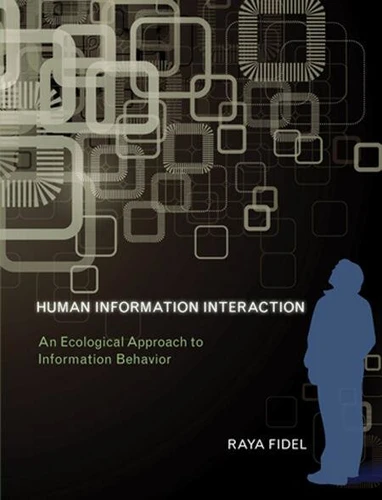
Human Information Interaction. An Ecological Approach to Information Behavior
Par :Formats :
Disponible dans votre compte client Decitre ou Furet du Nord dès validation de votre commande. Le format ePub protégé est :
- Compatible avec une lecture sur My Vivlio (smartphone, tablette, ordinateur)
- Compatible avec une lecture sur liseuses Vivlio
- Pour les liseuses autres que Vivlio, vous devez utiliser le logiciel Adobe Digital Edition. Non compatible avec la lecture sur les liseuses Kindle, Remarkable et Sony
- Non compatible avec un achat hors France métropolitaine
 , qui est-ce ?
Notre partenaire de plateforme de lecture numérique où vous retrouverez l'ensemble de vos ebooks gratuitement
Pour en savoir plus sur nos ebooks, consultez notre aide en ligne ici
C'est si simple ! Lisez votre ebook avec l'app Vivlio sur votre tablette, mobile ou ordinateur :

- Nombre de pages364
- FormatePub
- ISBN978-0-262-30070-4
- EAN9780262300704
- Date de parution23/03/2012
- Protection num.Adobe DRM
- Taille2 Mo
- Infos supplémentairesepub
- ÉditeurThe MIT Press
Résumé
A fresh research approach that bridges the study of human information interaction and the design of information systems. Human information interaction (HII) is an emerging area of study that investigates how people interact with information; its subfield human information behavior (HIB) is a flourishing, active discipline. Yet despite their obvious relevance to the design of information systems, these research areas have had almost no impact on systems design.
One issue may be the contextual complexity of human interaction with information; another may be the difficulty in translating real-life and unstructured HII complexity into formal, linear structures necessary for systems design. In this book, Raya Fidel proposes a research approach that bridges the study of human information interaction and the design of information systems: cognitive work analysis (CWA).
Developed by Jens Rasmussen and his colleagues, CWA embraces complexity and provides a conceptual framework and analytical tools that can harness it to create design requirements. CWA offers an ecological approach to design, analyzing the forces in the environment that shape human interaction with information. Fidel reviews research in HIB, focusing on its contribution to systems design, and then presents the CWA framework.
She shows that CWA, with its ecological approach, can be used to overcome design challenges and lead to the development of effective systems. Researchers and designers who use CWA can increase the diversity of their analytical tools, providing them with an alternative approach when they plan research and design projects. The CWA framework enables a collaboration between design and HII that can create information systems tailored to fit human lives.
One issue may be the contextual complexity of human interaction with information; another may be the difficulty in translating real-life and unstructured HII complexity into formal, linear structures necessary for systems design. In this book, Raya Fidel proposes a research approach that bridges the study of human information interaction and the design of information systems: cognitive work analysis (CWA).
Developed by Jens Rasmussen and his colleagues, CWA embraces complexity and provides a conceptual framework and analytical tools that can harness it to create design requirements. CWA offers an ecological approach to design, analyzing the forces in the environment that shape human interaction with information. Fidel reviews research in HIB, focusing on its contribution to systems design, and then presents the CWA framework.
She shows that CWA, with its ecological approach, can be used to overcome design challenges and lead to the development of effective systems. Researchers and designers who use CWA can increase the diversity of their analytical tools, providing them with an alternative approach when they plan research and design projects. The CWA framework enables a collaboration between design and HII that can create information systems tailored to fit human lives.