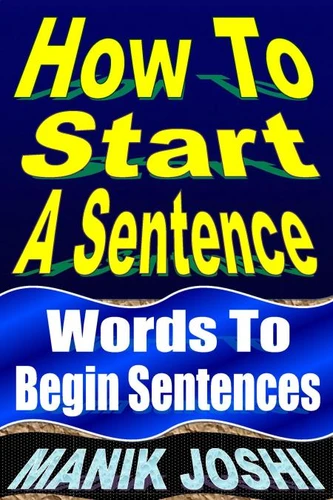
How to Start a Sentence: Words to Begin Sentences. English Daily Use, #1
Par :Formats :
Disponible dans votre compte client Decitre ou Furet du Nord dès validation de votre commande. Le format ePub est :
- Compatible avec une lecture sur My Vivlio (smartphone, tablette, ordinateur)
- Compatible avec une lecture sur liseuses Vivlio
- Pour les liseuses autres que Vivlio, vous devez utiliser le logiciel Adobe Digital Edition. Non compatible avec la lecture sur les liseuses Kindle, Remarkable et Sony
 , qui est-ce ?
Notre partenaire de plateforme de lecture numérique où vous retrouverez l'ensemble de vos ebooks gratuitement
Pour en savoir plus sur nos ebooks, consultez notre aide en ligne ici
C'est si simple ! Lisez votre ebook avec l'app Vivlio sur votre tablette, mobile ou ordinateur :

- FormatePub
- ISBN978-1-301-26891-7
- EAN9781301268917
- Date de parution08/02/2013
- Protection num.pas de protection
- Infos supplémentairesepub
- ÉditeurBluewater
Résumé
This Book Covers The Following Topics:How to Start a SentenceUsing 'AS'Using 'AFTER' and 'BEFORE'Using 'AT'Using 'BY'Using 'FOR/FROMUsing 'IF'Using 'OF/ON/OUT'Using 'TO'Using 'IN'Using 'WITH'Using 'WH-WORDS''Asking Questions'Using 'VERB WORD'Using 'ING' FORM of VERBSUsing 'PAST PARTICIPLES'Using '-LY Words'Using 'PRONOUNS'Transitional ExpressionsMiscellaneousExercises: 1(A) and 1(B)Exercises: 2(A) and 2(B)Sample This:There are different ways to start a sentence in English.
Using pronouns (I, we, you, they, he, she, it) is the most popular way to begin a sentence. But there are many other words that are widely used to start a sentence. They might be question words (what, where, etc.). They might be words formed from verbs, ending in -ing, -ed, -en, etc. Besides, words such as 'to' 'in' 'with', 'if', 'after' are also used to begin a sentence. Here, you will learn various words and phrases to start a sentence with.
Important Note:Starting a sentence with 'and' or 'but' is correct or not!Using 'And' or 'But' to begin a sentence is generally considered grammatically Incorrect. But there is no hard and fast rule in this regard. So, you can use 'And' or 'But' to begin a sentence. But avoid excessive use of these words to begin a sentence. Use these words at the beginning of a sentence only when they really give strength to your language.
Note: It is said that a sentence should not be begun with a conjunction of any kind, especially one of the FANBOYS (for, and, nor, but, or, yet, so). But this is not a hard and fast rule. Particularly in spoken English, starting a sentence with 'And' or 'But' is common.01. AS (used in place of 'when'; while something else is happening)As a person ages, his body weakens physically. As another year draws to a close, our attention turns to a new year.
As news of PM's hospitalization spread, fans and admirers began lining up outside the hospital. As the summer season approaches, I look forward to eating ice-creams. As the day progressed, over a hundred protestors gathered at the office. As the situation in the town worsened, jittery people rushed back to their homes. As the train pulled into the station, passengers rushed towards it. As the war widened, they had to leave the city.
As we grow older, we are more in control of our lives. As we progress, it is going to become more and more difficult.02. AS (used in place of 'because')As a policeman myself, I am aware of all the laws. As he got busy, his wife picked up the son. As sanitary workers are absent on most of the days, sweeping of roads is also irregular resulting in the trash along the road. As the electric cables are hanging loosely, it may anytime lead to a major accident if any passer-by comes into contact.
As the night temperature rose owing to the cloudy sky, there was some respite from cold conditions.03. AS (used in place of 'like')As in the past, the party president distanced herself from the government's unpopular decision.04. AS (used to introduce two events happening at the same time)As the bus was nearing, he moved aside. As the forces were conducting searches, the militants fired upon them, triggering an encounter.
As the mercury levels are dropping each day, difficulties for the poor are constantly rising.05. AS (used to add information)As you know, I have sent him a letter.06. AS (used to show 'in the way')As an interim arrangement, he directed the authorities not to return the land. As part of the deal, they will hand over control of five towns. As penance, he vowed to never scold any kid ever again.
Using pronouns (I, we, you, they, he, she, it) is the most popular way to begin a sentence. But there are many other words that are widely used to start a sentence. They might be question words (what, where, etc.). They might be words formed from verbs, ending in -ing, -ed, -en, etc. Besides, words such as 'to' 'in' 'with', 'if', 'after' are also used to begin a sentence. Here, you will learn various words and phrases to start a sentence with.
Important Note:Starting a sentence with 'and' or 'but' is correct or not!Using 'And' or 'But' to begin a sentence is generally considered grammatically Incorrect. But there is no hard and fast rule in this regard. So, you can use 'And' or 'But' to begin a sentence. But avoid excessive use of these words to begin a sentence. Use these words at the beginning of a sentence only when they really give strength to your language.
Note: It is said that a sentence should not be begun with a conjunction of any kind, especially one of the FANBOYS (for, and, nor, but, or, yet, so). But this is not a hard and fast rule. Particularly in spoken English, starting a sentence with 'And' or 'But' is common.01. AS (used in place of 'when'; while something else is happening)As a person ages, his body weakens physically. As another year draws to a close, our attention turns to a new year.
As news of PM's hospitalization spread, fans and admirers began lining up outside the hospital. As the summer season approaches, I look forward to eating ice-creams. As the day progressed, over a hundred protestors gathered at the office. As the situation in the town worsened, jittery people rushed back to their homes. As the train pulled into the station, passengers rushed towards it. As the war widened, they had to leave the city.
As we grow older, we are more in control of our lives. As we progress, it is going to become more and more difficult.02. AS (used in place of 'because')As a policeman myself, I am aware of all the laws. As he got busy, his wife picked up the son. As sanitary workers are absent on most of the days, sweeping of roads is also irregular resulting in the trash along the road. As the electric cables are hanging loosely, it may anytime lead to a major accident if any passer-by comes into contact.
As the night temperature rose owing to the cloudy sky, there was some respite from cold conditions.03. AS (used in place of 'like')As in the past, the party president distanced herself from the government's unpopular decision.04. AS (used to introduce two events happening at the same time)As the bus was nearing, he moved aside. As the forces were conducting searches, the militants fired upon them, triggering an encounter.
As the mercury levels are dropping each day, difficulties for the poor are constantly rising.05. AS (used to add information)As you know, I have sent him a letter.06. AS (used to show 'in the way')As an interim arrangement, he directed the authorities not to return the land. As part of the deal, they will hand over control of five towns. As penance, he vowed to never scold any kid ever again.