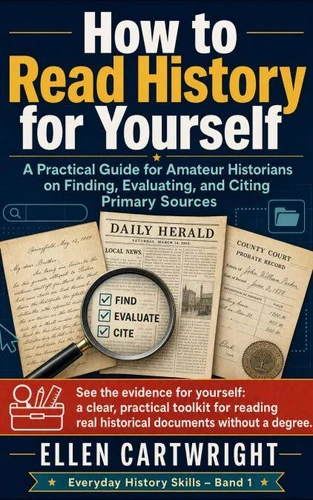
You don't need a degree in history to read real historical evidence.
Every day, readers argue about books like Night, Sapiens, or A People's History of the United States-but very few ever look at the documents behind the stories. This book shows you, step by step, how to find and read those primary sources for yourself.
How to Read History for Yourself is a short, practical guide for general readers who love narrative history and want to check the evidence.
Whether you're in a book club, exploring your town's past, researching a family story, or just tired of taking big historical claims on trust, this book gives you a clear, non-academic way in.
You will learn how to:
- Recognize what really counts as a primary source
Letters, diaries, court records, government files, photographs, newspapers, oral testimonies, maps, artifacts, and more-what they are, what they are not, and how they differ from secondary sources.
- Trace claims back to the evidence
Follow the footnotes in popular history books, documentaries, and podcasts to find the original documents behind dramatic scenes and big arguments.
- Find sources in the real and digital world
Use public libraries, local and state archives, historical societies, and major online collections to locate materials-without insider knowledge or academic access.
- Read a primary source quickly but intelligently
Apply a simple "first contact" routine: who made this, when, for whom, and why? Learn what to skim, what to slow down for, and what to write down.
- Spot bias, blind spots, and outright lies
Assess trustworthiness without specialist training by asking focused questions about motive, audience, power, and what (or who) is missing.
- Put documents into context
Build enough background around a source to understand it properly using reference works, timelines, and basic fact-checking tools that
You don't need a degree in history to read real historical evidence.
Every day, readers argue about books like Night, Sapiens, or A People's History of the United States-but very few ever look at the documents behind the stories. This book shows you, step by step, how to find and read those primary sources for yourself.
How to Read History for Yourself is a short, practical guide for general readers who love narrative history and want to check the evidence.
Whether you're in a book club, exploring your town's past, researching a family story, or just tired of taking big historical claims on trust, this book gives you a clear, non-academic way in.
You will learn how to:
- Recognize what really counts as a primary source
Letters, diaries, court records, government files, photographs, newspapers, oral testimonies, maps, artifacts, and more-what they are, what they are not, and how they differ from secondary sources.
- Trace claims back to the evidence
Follow the footnotes in popular history books, documentaries, and podcasts to find the original documents behind dramatic scenes and big arguments.
- Find sources in the real and digital world
Use public libraries, local and state archives, historical societies, and major online collections to locate materials-without insider knowledge or academic access.
- Read a primary source quickly but intelligently
Apply a simple "first contact" routine: who made this, when, for whom, and why? Learn what to skim, what to slow down for, and what to write down.
- Spot bias, blind spots, and outright lies
Assess trustworthiness without specialist training by asking focused questions about motive, audience, power, and what (or who) is missing.
- Put documents into context
Build enough background around a source to understand it properly using reference works, timelines, and basic fact-checking tools that