
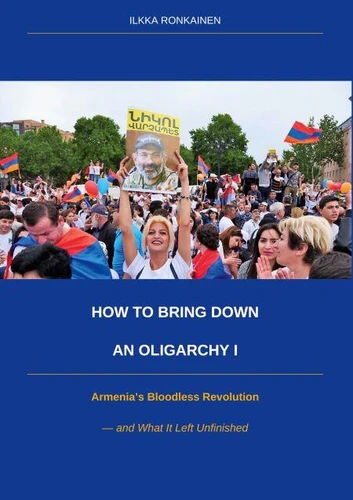
Ilkka Ronkainen (born 1949) is a Finnish social scientist, management consultant, and author who helped Finland build one of the world's most admired public sectors, moved to Armenia 2010 to develop the oligarchic country. He witnessed Armenia's bloodless Velvet Revolution. Ronkainen has written over twenty books about society and his own life.
How to Bring Down an Oligarchy I. Armenia's Bloodless Revolution and What It Left Unfinished
Par :Formats :
Disponible dans votre compte client Decitre ou Furet du Nord dès validation de votre commande. Le format ePub est :
- Compatible avec une lecture sur My Vivlio (smartphone, tablette, ordinateur)
- Compatible avec une lecture sur liseuses Vivlio
- Pour les liseuses autres que Vivlio, vous devez utiliser le logiciel Adobe Digital Edition. Non compatible avec la lecture sur les liseuses Kindle, Remarkable et Sony
 , qui est-ce ?
Notre partenaire de plateforme de lecture numérique où vous retrouverez l'ensemble de vos ebooks gratuitement
Pour en savoir plus sur nos ebooks, consultez notre aide en ligne ici
C'est si simple ! Lisez votre ebook avec l'app Vivlio sur votre tablette, mobile ou ordinateur :

- Nombre de pages228
- FormatePub
- ISBN978-952-89-4038-8
- EAN9789528940388
- Date de parution28/05/2026
- Protection num.Digital Watermarking
- Taille7 Mo
- Infos supplémentairesepub
- ÉditeurBoD - Books on Demand
Résumé
In the spring of 2018, one man began by walking.
He did not know he would win. He only knew that standing still had become impossible.
Twenty-six days later, the oligarchy fell without a single death.
Ilkka Ronkainen was there. He lived next door to the Armenian parliament, walked the streets of Yerevan day after day, and wrote every evening. He watched a revolution take shape from twenty meters away and watched what was left unbuilt in its aftermath.
This book is his account of both.
The first part is a day-by-day diary of Armenia's Velvet Revolution of 2018, one of the most remarkable political events of the twenty-first century.
The second part asks the harder question: eight years later, what did the revolution actually deliver? Elections became genuinely free. The economy grew at extraordinary speed. Fear weakened. But high-level corruption remained unpunished, the judiciary never became truly independent, and the deep structures of oligarchic power adapted rather than disappeared. Armenia proved that a population can withdraw its consent from a corrupt system and prevail: peacefully, joyfully, and with overwhelming unity. What it could not yet prove is how to make that change permanent. Power is not untouchable.
Systems that appear permanent are not permanent. Fear is not permanent.
The second part asks the harder question: eight years later, what did the revolution actually deliver? Elections became genuinely free. The economy grew at extraordinary speed. Fear weakened. But high-level corruption remained unpunished, the judiciary never became truly independent, and the deep structures of oligarchic power adapted rather than disappeared. Armenia proved that a population can withdraw its consent from a corrupt system and prevail: peacefully, joyfully, and with overwhelming unity. What it could not yet prove is how to make that change permanent. Power is not untouchable.
Systems that appear permanent are not permanent. Fear is not permanent.
A propos de Ilkka Ronkainen


10,99 €