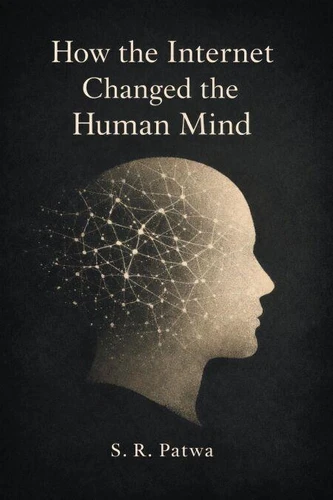
How the Internet Changed the Human Mind is a reflective examination of one of the most significant yet least consciously understood transformations of modern life. Rather than treating the internet as a tool or a technological milestone, this book approaches it as a sustained environment, one that has quietly reshaped how human attention, memory, judgment, and inner life function on a daily basis.
The book begins by situating the human mind in its pre-digital condition, when information arrived intermittently and thought unfolded at a pace shaped by physical limits, social rhythms, and natural pauses. Against this backdrop, the internet is introduced not as a sudden disruption but as a gradual shift from occasional exposure to permanent presence. Over time, this continuous connectivity altered the conditions under which the mind operates, often without deliberate choice or awareness.
Central to the book is the idea that attention is not an unlimited resource. The internet did not merely compete for attention; it reorganized how attention is distributed, fragmented, and replenished. The speed of digital information, the compression of time, and the constant invitation to respond have subtly changed how people think, decide, and remember. Judgment, once shaped by reflection and context, increasingly occurs under conditions of immediacy and overload.
Rather than offering alarmist claims or simplistic conclusions, the book takes a calm, analytical approach. It draws from psychology, cognitive science, social observation, and civilizational history to show how mental habits evolve when the surrounding environment changes. The focus remains on everyday mental life, how people read, absorb information, feel restless or overstimulated, and struggle to sustain depth in a world designed for movement rather than stillness.
The later chapters explore how these changes affect memory, emotional regulation, and the capacity for sustained thought. The internet's influence is shown not as inherently harmful or beneficial, but as powerful and structural. What matters is not individual willpower alone, but whether societies understand the mental costs of permanent exposure and adapt accordingly. Written in a measured, uninterrupted narrative style, the book avoids slogans, prescriptions, and self-help formulas.
It is intended for readers who sense that their inner lives have changed but struggle to articulate how or why. How the Internet Changed the Human Mind offers clarity rather than solutions, understanding rather than judgment, and invites the reader to see modern mental life with greater awareness and depth.
How the Internet Changed the Human Mind is a reflective examination of one of the most significant yet least consciously understood transformations of modern life. Rather than treating the internet as a tool or a technological milestone, this book approaches it as a sustained environment, one that has quietly reshaped how human attention, memory, judgment, and inner life function on a daily basis.
The book begins by situating the human mind in its pre-digital condition, when information arrived intermittently and thought unfolded at a pace shaped by physical limits, social rhythms, and natural pauses. Against this backdrop, the internet is introduced not as a sudden disruption but as a gradual shift from occasional exposure to permanent presence. Over time, this continuous connectivity altered the conditions under which the mind operates, often without deliberate choice or awareness.
Central to the book is the idea that attention is not an unlimited resource. The internet did not merely compete for attention; it reorganized how attention is distributed, fragmented, and replenished. The speed of digital information, the compression of time, and the constant invitation to respond have subtly changed how people think, decide, and remember. Judgment, once shaped by reflection and context, increasingly occurs under conditions of immediacy and overload.
Rather than offering alarmist claims or simplistic conclusions, the book takes a calm, analytical approach. It draws from psychology, cognitive science, social observation, and civilizational history to show how mental habits evolve when the surrounding environment changes. The focus remains on everyday mental life, how people read, absorb information, feel restless or overstimulated, and struggle to sustain depth in a world designed for movement rather than stillness.
The later chapters explore how these changes affect memory, emotional regulation, and the capacity for sustained thought. The internet's influence is shown not as inherently harmful or beneficial, but as powerful and structural. What matters is not individual willpower alone, but whether societies understand the mental costs of permanent exposure and adapt accordingly. Written in a measured, uninterrupted narrative style, the book avoids slogans, prescriptions, and self-help formulas.
It is intended for readers who sense that their inner lives have changed but struggle to articulate how or why. How the Internet Changed the Human Mind offers clarity rather than solutions, understanding rather than judgment, and invites the reader to see modern mental life with greater awareness and depth.


 , qui est-ce ?