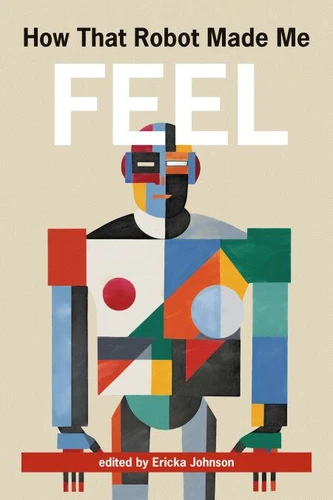
An edited collection that explores what emotions we have when encountering robots, how we react emotionally to them in different contexts, and why these emotional responses are so important. Do robots, or the AI that is driving them, have emotions? That is a hotly debated topic-both in science fiction, where such assertions are a staple of the narrative, and in tech development, where it often makes headlines.
But what about how we humans emotionally respond to robots? Are our emotional responses any less important when it comes to how the robots we encounter today are designed? In How That Robot Made Me Feel, Ericka Johnson asks the authors in this collection to critically examine our emotional and affective responses to robots, and what such an examination would do to the way roboticists use (or toy with) our emotions in their design decisions.
The narrative arc of this anthology follows the question of just whose emotions are being engaged through robotic interactions, why, and for what design ends. Of course, the answer is that it is our emotions that are interesting. And these emotions are not universal, despite the historically universalist paradigm of AI and how robotic emotions work. Emotions are contingent, to borrow a commonly used phrase in feminist technoscience.
They are placed in space, time, and cultural context. And understanding how they are produced and engaged with will help clarify many of the political aspects of robotic interaction that are currently concealed by the shiny and allegedly neutral surfaces of robots.
An edited collection that explores what emotions we have when encountering robots, how we react emotionally to them in different contexts, and why these emotional responses are so important. Do robots, or the AI that is driving them, have emotions? That is a hotly debated topic-both in science fiction, where such assertions are a staple of the narrative, and in tech development, where it often makes headlines.
But what about how we humans emotionally respond to robots? Are our emotional responses any less important when it comes to how the robots we encounter today are designed? In How That Robot Made Me Feel, Ericka Johnson asks the authors in this collection to critically examine our emotional and affective responses to robots, and what such an examination would do to the way roboticists use (or toy with) our emotions in their design decisions.
The narrative arc of this anthology follows the question of just whose emotions are being engaged through robotic interactions, why, and for what design ends. Of course, the answer is that it is our emotions that are interesting. And these emotions are not universal, despite the historically universalist paradigm of AI and how robotic emotions work. Emotions are contingent, to borrow a commonly used phrase in feminist technoscience.
They are placed in space, time, and cultural context. And understanding how they are produced and engaged with will help clarify many of the political aspects of robotic interaction that are currently concealed by the shiny and allegedly neutral surfaces of robots.


 , qui est-ce ?
