
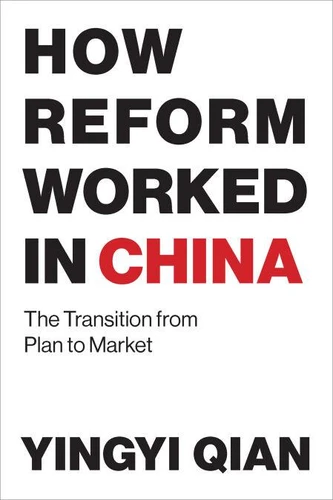
How Reform Worked in China. The Transition from Plan to Market
Par :Formats :
Disponible dans votre compte client Decitre ou Furet du Nord dès validation de votre commande. Le format ePub protégé est :
- Compatible avec une lecture sur My Vivlio (smartphone, tablette, ordinateur)
- Compatible avec une lecture sur liseuses Vivlio
- Pour les liseuses autres que Vivlio, vous devez utiliser le logiciel Adobe Digital Edition. Non compatible avec la lecture sur les liseuses Kindle, Remarkable et Sony
- Non compatible avec un achat hors France métropolitaine
 , qui est-ce ?
Notre partenaire de plateforme de lecture numérique où vous retrouverez l'ensemble de vos ebooks gratuitement
Pour en savoir plus sur nos ebooks, consultez notre aide en ligne ici
C'est si simple ! Lisez votre ebook avec l'app Vivlio sur votre tablette, mobile ou ordinateur :

- Nombre de pages412
- FormatePub
- ISBN978-0-262-34271-1
- EAN9780262342711
- Date de parution24/11/2017
- Protection num.Adobe DRM
- Taille4 Mo
- Infos supplémentairesepub
- ÉditeurThe MIT Press
Résumé
A noted Chinese economist examines the mechanisms behind China's economic reforms, arguing that universal principles and specific implementations are equally important. As China has transformed itself from a centrally planned economy to a market economy, economists have tried to understand and interpret the success of Chinese reform. As the Chinese economist Yingyi Qian explains, there are two schools of thought on Chinese reform: the "School of Universal Principles, " which ascribes China's successful reform to the workings of the free market, and the "School of Chinese Characteristics, " which holds that China's reform is successful precisely because it did not follow the economics of the market but instead relied on the government.
In this book, Qian offers a third perspective, taking certain elements from each school of thought but emphasizing not why reform worked but how it did. Economics is a science, but economic reform is applied science and engineering. To a practitioner, it is more useful to find a feasible reform path than the theoretically best way. The key to understanding how reform has worked in China, Qian argues, is to consider the way reform designs respond to initial historical conditions and contemporary constraints.
Qian examines the role of "transitional institutions"-not "best practice institutions" but "incentive-compatible institutions"-in Chinese reform; the dual-track approach to market liberalization; the ownership of firms, viewed both theoretically and empirically; government decentralization, offering and testing hypotheses about its link to local economic development; and the specific historical conditions of China's regional-based central planning.
In this book, Qian offers a third perspective, taking certain elements from each school of thought but emphasizing not why reform worked but how it did. Economics is a science, but economic reform is applied science and engineering. To a practitioner, it is more useful to find a feasible reform path than the theoretically best way. The key to understanding how reform has worked in China, Qian argues, is to consider the way reform designs respond to initial historical conditions and contemporary constraints.
Qian examines the role of "transitional institutions"-not "best practice institutions" but "incentive-compatible institutions"-in Chinese reform; the dual-track approach to market liberalization; the ownership of firms, viewed both theoretically and empirically; government decentralization, offering and testing hypotheses about its link to local economic development; and the specific historical conditions of China's regional-based central planning.