
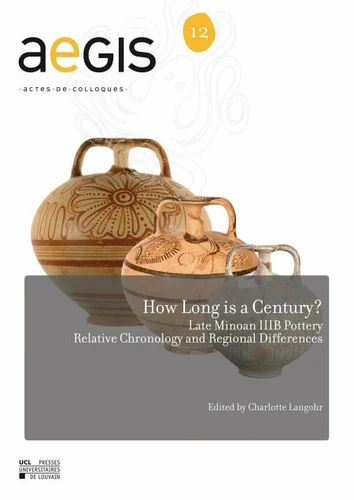
How Long is a Century?. Late Minoan IIIB Pottery Relative Chronology and Regional Differences
Par :Formats :
Disponible dans votre compte client Decitre ou Furet du Nord dès validation de votre commande. Le format Multi-format est :
- Pour les liseuses autres que Vivlio, vous devez utiliser le logiciel Adobe Digital Edition. Non compatible avec la lecture sur les liseuses Kindle, Remarkable et Sony
 , qui est-ce ?
Notre partenaire de plateforme de lecture numérique où vous retrouverez l'ensemble de vos ebooks gratuitement
Pour en savoir plus sur nos ebooks, consultez notre aide en ligne ici
C'est si simple ! Lisez votre ebook avec l'app Vivlio sur votre tablette, mobile ou ordinateur :

- Nombre de pages414
- FormatMulti-format
- ISBN978-2-39061-040-3
- EAN9782390610403
- Date de parution03/06/2021
- Protection num.pas de protection
- Infos supplémentairesMulti-Format
- ÉditeurPresses universitaires de Louvai...
Résumé
Covering approximately the century between 1300 and 1200 BC, the Late Minoan IIIB phase remains a blurred episode of Minoan civilisation. Archaeological data present a contradictory picture: on the one hand, they suggest a time of prosperity. with favourable conditions of subsistence and growth; on the other hand, there are signs of trouble illustrated by a series of abandonments of century-old occupied settlements.
Did these processes take place simultaneously, in succession or were they punctual? Can we make sense of the various hale Minoan IIIB developments from a chronological perspective? How can a region-by region analysis inform us about the various island communities and their histories during the 13th century BC? The international workshop which the present volume reflects took place at the UCLouvainin Belgium on the 24th and 25th of October 2013.
It specifically addressed these questions and focused on the gradual transformation of Cretan society throughout the 13th century BC by concentrating on a single aspect of its material culture: the pottery. It was our infention to bring together a number of ceramic experts in charge of the study of Late Minoan IIIB pottery deposits in a selection of Cretan sites. We wanted them to discuss, confront and contextualise their respective assemblages.
The gathering was successful in many ways and not in the least because not only we managed to progress on a variety of thorny issues but it was also a real treat to assist in the thrilling exchanges between the inspiring personalities who compose the 'family' of Minoan (and Mycenaean) pottery specialists.
Did these processes take place simultaneously, in succession or were they punctual? Can we make sense of the various hale Minoan IIIB developments from a chronological perspective? How can a region-by region analysis inform us about the various island communities and their histories during the 13th century BC? The international workshop which the present volume reflects took place at the UCLouvainin Belgium on the 24th and 25th of October 2013.
It specifically addressed these questions and focused on the gradual transformation of Cretan society throughout the 13th century BC by concentrating on a single aspect of its material culture: the pottery. It was our infention to bring together a number of ceramic experts in charge of the study of Late Minoan IIIB pottery deposits in a selection of Cretan sites. We wanted them to discuss, confront and contextualise their respective assemblages.
The gathering was successful in many ways and not in the least because not only we managed to progress on a variety of thorny issues but it was also a real treat to assist in the thrilling exchanges between the inspiring personalities who compose the 'family' of Minoan (and Mycenaean) pottery specialists.
A propos de Charlotte Langohr
10,00 €

10,00 €