
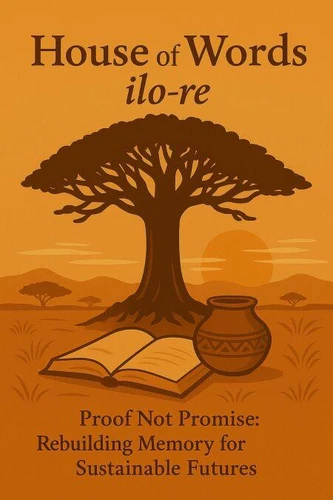
House of Words - ilo-re
Par :Formats :
Disponible dans votre compte client Decitre ou Furet du Nord dès validation de votre commande. Le format ePub est :
- Compatible avec une lecture sur My Vivlio (smartphone, tablette, ordinateur)
- Compatible avec une lecture sur liseuses Vivlio
- Pour les liseuses autres que Vivlio, vous devez utiliser le logiciel Adobe Digital Edition. Non compatible avec la lecture sur les liseuses Kindle, Remarkable et Sony
 , qui est-ce ?
Notre partenaire de plateforme de lecture numérique où vous retrouverez l'ensemble de vos ebooks gratuitement
Pour en savoir plus sur nos ebooks, consultez notre aide en ligne ici
C'est si simple ! Lisez votre ebook avec l'app Vivlio sur votre tablette, mobile ou ordinateur :

- FormatePub
- ISBN978-1-0682395-8-8
- EAN9781068239588
- Date de parution15/10/2025
- Protection num.pas de protection
- Infos supplémentairesepub
- ÉditeurRBKCL - Publishing Ltd
Résumé
This Book is written for easy learning from native language(s) and that is to addressee the error; contemporary African languages are written and read as if they stand alone, stripped of the discipline of comparison ? association of ideas. They are taught in schools and printed in books without recognising loan words, cross-language associations, or the fetching method - the simple act of placing L1 beside L2 and L3 to see how meaning lives, shifts, and survives.
This is the pitfall: pupils learn Lugwere, Luganda, Kiswahili, or other African languages as if they are sealed containers, while every language is a river that borrows and gives. Without comparative method, children are left thinking their words are either weak or inferior to English, instead of discovering that loan words are part of a living network of knowledge. House of Words - ilo-re directly addresses this problem.
The Lugwere word ilo-re means "eye as the doorway of the house placed side by side with the Ranykemet word ir, they reveal common regularity" the twosome are not only about sight but about memory, belonging, and entry into wisdom. This book uses ilo-re as a symbol for how to re-open African languages with method. It demonstrates how comparing Lugwere (L1) with English (L2) and neighbouring languages (L3) is not optional but necessary.
Through comparison, pupils learn what is preserved in L1, what is narrowed in L2, and what is borrowed in L3. The subtitle Proof Not Promise: Rebuilding Memory for Sustainable Future captures the urgency. Africa does not need another promise about heritage; rather, Africa needs proof. Proof comes when words are studied with discipline: when orthography cards show the real roots of ilo-re, Kilorelo, owe'ika, e'nkabii, and more.
Proof comes when teachers and pupils learn that loan words are not weakness but evidence of connection - of how languages fetch and share meaning across generations. This book gives educators and communities practical tools: orthography and etymology cards for Grades 1-6, pilot pathways for storytelling in schools, recognition for teachers through micro-credentials, and methods for community revision and exchange.
It is a manual of action as much as it is a cultural offering. For families, policymakers, and international readers, House of Words - ilo-re is both testimony and guide. It names the error - African languages written without method - and offers a clear alternative: awaken them with comparative discipline. It is time to rebuild reading and writing through fetching method, where every word is proof, not promise, of sustainable futures.
This is the pitfall: pupils learn Lugwere, Luganda, Kiswahili, or other African languages as if they are sealed containers, while every language is a river that borrows and gives. Without comparative method, children are left thinking their words are either weak or inferior to English, instead of discovering that loan words are part of a living network of knowledge. House of Words - ilo-re directly addresses this problem.
The Lugwere word ilo-re means "eye as the doorway of the house placed side by side with the Ranykemet word ir, they reveal common regularity" the twosome are not only about sight but about memory, belonging, and entry into wisdom. This book uses ilo-re as a symbol for how to re-open African languages with method. It demonstrates how comparing Lugwere (L1) with English (L2) and neighbouring languages (L3) is not optional but necessary.
Through comparison, pupils learn what is preserved in L1, what is narrowed in L2, and what is borrowed in L3. The subtitle Proof Not Promise: Rebuilding Memory for Sustainable Future captures the urgency. Africa does not need another promise about heritage; rather, Africa needs proof. Proof comes when words are studied with discipline: when orthography cards show the real roots of ilo-re, Kilorelo, owe'ika, e'nkabii, and more.
Proof comes when teachers and pupils learn that loan words are not weakness but evidence of connection - of how languages fetch and share meaning across generations. This book gives educators and communities practical tools: orthography and etymology cards for Grades 1-6, pilot pathways for storytelling in schools, recognition for teachers through micro-credentials, and methods for community revision and exchange.
It is a manual of action as much as it is a cultural offering. For families, policymakers, and international readers, House of Words - ilo-re is both testimony and guide. It names the error - African languages written without method - and offers a clear alternative: awaken them with comparative discipline. It is time to rebuild reading and writing through fetching method, where every word is proof, not promise, of sustainable futures.