SOLDES
Jusqu'à -70% sur une sélection d'articles*

Nouveauté
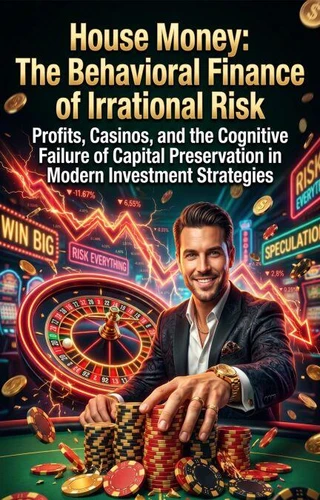
House Money: The Behavioral Finance of Irrational Risk. Profits, Casinos, and the Cognitive Failure of Capital Preservation in Modern Investment Strategies
Par :Formats :
Disponible dans votre compte client Decitre ou Furet du Nord dès validation de votre commande. Le format ePub est :
- Compatible avec une lecture sur My Vivlio (smartphone, tablette, ordinateur)
- Compatible avec une lecture sur liseuses Vivlio
- Pour les liseuses autres que Vivlio, vous devez utiliser le logiciel Adobe Digital Edition. Non compatible avec la lecture sur les liseuses Kindle, Remarkable et Sony
 , qui est-ce ?
Notre partenaire de plateforme de lecture numérique où vous retrouverez l'ensemble de vos ebooks gratuitement
Pour en savoir plus sur nos ebooks, consultez notre aide en ligne ici
C'est si simple ! Lisez votre ebook avec l'app Vivlio sur votre tablette, mobile ou ordinateur :

- Nombre de pages203
- FormatePub
- ISBN978-3-565-49728-7
- EAN9783565497287
- Date de parution14/06/2026
- Protection num.pas de protection
- Taille844 Ko
- Infos supplémentairesepub
- ÉditeurEmphaloz Publishing House
Résumé
Why do highly disciplined investors suddenly start making reckless, illogical trades immediately after securing a large profit? They are not suffering from overconfidence; they are falling into a deeply ingrained psychological trap known in behavioral finance as the House Money Effect.
Derived from casino gambling, this cognitive bias occurs when individuals fail to fully integrate new winnings into their personal net worth.
Instead of treating the newly acquired capital as their own hard-earned money, they subconsciously compartmentalize it as "the house's money." Because it feels like free capital, the brain's natural risk-aversion completely shuts down, leading to aggressively speculative behavior. This flaw explains why so many successful day traders and lottery winners inevitably give all their profits back to the market within a shockingly short period. This rigorous psychological analysis deconstructs the emotional vulnerabilities of wealth management.
It explores the dangerous mental accounting errors that plague modern retail investing, the neurological spike of sudden windfalls, and actionable strategies to forcefully reset your financial baseline. Secure your hard-won capital. Understanding the House Money Effect provides the critical psychological discipline required to stop treating your own profits like a temporary casino loan.
Instead of treating the newly acquired capital as their own hard-earned money, they subconsciously compartmentalize it as "the house's money." Because it feels like free capital, the brain's natural risk-aversion completely shuts down, leading to aggressively speculative behavior. This flaw explains why so many successful day traders and lottery winners inevitably give all their profits back to the market within a shockingly short period. This rigorous psychological analysis deconstructs the emotional vulnerabilities of wealth management.
It explores the dangerous mental accounting errors that plague modern retail investing, the neurological spike of sudden windfalls, and actionable strategies to forcefully reset your financial baseline. Secure your hard-won capital. Understanding the House Money Effect provides the critical psychological discipline required to stop treating your own profits like a temporary casino loan.