
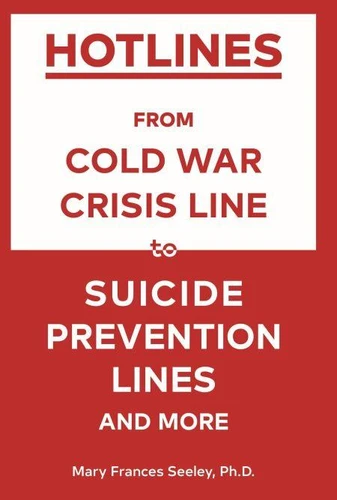
Hotlines: From Cold War Crisis Lines to Suicide Prevention Lines and More
Par :Formats :
Disponible dans votre compte client Decitre ou Furet du Nord dès validation de votre commande. Le format ePub est :
- Compatible avec une lecture sur My Vivlio (smartphone, tablette, ordinateur)
- Compatible avec une lecture sur liseuses Vivlio
- Pour les liseuses autres que Vivlio, vous devez utiliser le logiciel Adobe Digital Edition. Non compatible avec la lecture sur les liseuses Kindle, Remarkable et Sony
 , qui est-ce ?
Notre partenaire de plateforme de lecture numérique où vous retrouverez l'ensemble de vos ebooks gratuitement
Pour en savoir plus sur nos ebooks, consultez notre aide en ligne ici
C'est si simple ! Lisez votre ebook avec l'app Vivlio sur votre tablette, mobile ou ordinateur :

- FormatePub
- ISBN8230574712
- EAN9798230574712
- Date de parution04/10/2024
- Protection num.pas de protection
- Infos supplémentairesepub
- ÉditeurIndependently Published
Résumé
The Cuban Missile Crisis in 1963 was of international importance, threatening the world with the potential suicide of at least three nations: the United States, the Soviet Union, and Cuba. The threat was the potential annihilation of the warring nations using nuclear weapons. The crisis was averted using a newly established telephone system between President John F. Kennedy of the United States and Premier Nikita Khrushchev of the Soviet Union. As disastrous as this could be, it gave birth to an actual service of preventing the suicide of military service veterans and extended to the general population of the United States and beyond.
The hotline movement grew from this potential disaster to a service that offered multiple services, not only preventing suicides but also providing social services such as providing information and referrals, comforting the lonely, the depressed, and those isolated from family, and other necessary resources. This book portrays the image and development of hotlines by tracing the roots of the hotline movement, beginning with the coinage of the word during the Cuban Missile Crisis.
It goes on to explain how it expanded and spread throughout the mental health and social services arena in the US. Copious examples are given to express the callers' needs and how the distressed callers responded to and received them. The hotline comes into its fulfillment with the compassionate relationship established between the trained volunteer responder and the caller looking for comfort and peace in the vicissitudes of life. The natural effect of the hotline is looking at the fruits it produces.
The compassionate contact between the caller and the volunteer responder supports these fruits. The caller learns to trust the volunteer and confides in them, resulting in a more contented, satisfactory life on the caller's part. These efforts on the part of the volunteer are supported by Dr. Vivek Murthy, the 19th Surgeon General of the United States, in his book, Together: The Healing Power of Human Connection in a Sometimes Lonely World.
He exemplifies how a compassionate listener, such as a skilled volunteer, can bring peace and comfort over the telephone to a lonely or isolated person. When using Dr. Murthy's information by offering this healing to a repeat caller, the volunteer follows up by using Dr. Ted Dunn's model or technique to use his five Dynamic Elements in his book, Graced Crossroads, Pathways to Deep Change & Transformation.
This technique gives the trained volunteer the
The hotline movement grew from this potential disaster to a service that offered multiple services, not only preventing suicides but also providing social services such as providing information and referrals, comforting the lonely, the depressed, and those isolated from family, and other necessary resources. This book portrays the image and development of hotlines by tracing the roots of the hotline movement, beginning with the coinage of the word during the Cuban Missile Crisis.
It goes on to explain how it expanded and spread throughout the mental health and social services arena in the US. Copious examples are given to express the callers' needs and how the distressed callers responded to and received them. The hotline comes into its fulfillment with the compassionate relationship established between the trained volunteer responder and the caller looking for comfort and peace in the vicissitudes of life. The natural effect of the hotline is looking at the fruits it produces.
The compassionate contact between the caller and the volunteer responder supports these fruits. The caller learns to trust the volunteer and confides in them, resulting in a more contented, satisfactory life on the caller's part. These efforts on the part of the volunteer are supported by Dr. Vivek Murthy, the 19th Surgeon General of the United States, in his book, Together: The Healing Power of Human Connection in a Sometimes Lonely World.
He exemplifies how a compassionate listener, such as a skilled volunteer, can bring peace and comfort over the telephone to a lonely or isolated person. When using Dr. Murthy's information by offering this healing to a repeat caller, the volunteer follows up by using Dr. Ted Dunn's model or technique to use his five Dynamic Elements in his book, Graced Crossroads, Pathways to Deep Change & Transformation.
This technique gives the trained volunteer the