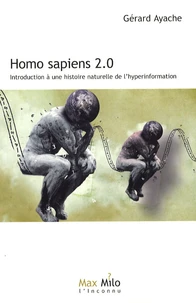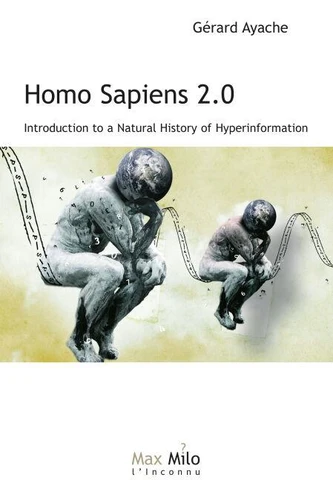
Homo Sapiens 2.0. Introduction to a Natural History of Hyperinformation
Par :Formats :
Disponible dans votre compte client Decitre ou Furet du Nord dès validation de votre commande. Le format ePub protégé est :
- Compatible avec une lecture sur My Vivlio (smartphone, tablette, ordinateur)
- Compatible avec une lecture sur liseuses Vivlio
- Pour les liseuses autres que Vivlio, vous devez utiliser le logiciel Adobe Digital Edition. Non compatible avec la lecture sur les liseuses Kindle, Remarkable et Sony
- Non compatible avec un achat hors France métropolitaine
 , qui est-ce ?
Notre partenaire de plateforme de lecture numérique où vous retrouverez l'ensemble de vos ebooks gratuitement
Pour en savoir plus sur nos ebooks, consultez notre aide en ligne ici
C'est si simple ! Lisez votre ebook avec l'app Vivlio sur votre tablette, mobile ou ordinateur :

- Nombre de pages256
- FormatePub
- ISBN978-2-315-01179-7
- EAN9782315011797
- Date de parution09/06/2023
- Protection num.Adobe DRM
- Taille1 Mo
- Infos supplémentairesepub
- ÉditeurMax Milo
Résumé
How can we use information rather than be subjected to it? Does life have a digital logic? Is the internal structure of the universe made up of information? Is the Internet generating a collective brain?
Ever since Homo sapiens, armed with his electronic machines, learned to unlock the secret of information and its alchemy by digitizing it, he has unleashed hyperinformation. This force is a subtle blend of matter and thought, animate and inanimate, virtual and real.
For the first time in human history, technology seems to be generating a collective intelligence. Does this mean that reason is becoming truly alien to itself, potentially hostile and dangerous? Or are we witnessing the happy dawn of a new era? Homo sapiens 2.0 offers a journey into the mysteries of the human brain, the mysteries of genes and memes (their mental equivalent), and the secrets of language, religion and new technologies.
From René Girard to Richard Dawkins, from Teilhard de Chardin to Joël de Rosnay, the author recounts the saga of thought in the age of the virtual. In-between each chapter, "Interludes" take us on a journey through literary works or enlightening scientific experiments. Gérard Ayache has taught communications at the University of Paris-I, worked as director of a public television channel and heads the Institut Infométrie.
For the first time in human history, technology seems to be generating a collective intelligence. Does this mean that reason is becoming truly alien to itself, potentially hostile and dangerous? Or are we witnessing the happy dawn of a new era? Homo sapiens 2.0 offers a journey into the mysteries of the human brain, the mysteries of genes and memes (their mental equivalent), and the secrets of language, religion and new technologies.
From René Girard to Richard Dawkins, from Teilhard de Chardin to Joël de Rosnay, the author recounts the saga of thought in the age of the virtual. In-between each chapter, "Interludes" take us on a journey through literary works or enlightening scientific experiments. Gérard Ayache has taught communications at the University of Paris-I, worked as director of a public television channel and heads the Institut Infométrie.