SOLDES
Jusqu'à -70% sur une sélection d'articles*

Nouveauté
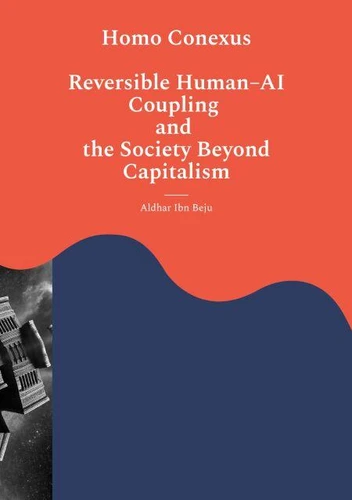
Homo Conexus. Reversible Human AI Coupling and the Society Beyond Capitalism
Par :Formats :
Disponible dans votre compte client Decitre ou Furet du Nord dès validation de votre commande. Le format ePub est :
- Compatible avec une lecture sur My Vivlio (smartphone, tablette, ordinateur)
- Compatible avec une lecture sur liseuses Vivlio
- Pour les liseuses autres que Vivlio, vous devez utiliser le logiciel Adobe Digital Edition. Non compatible avec la lecture sur les liseuses Kindle, Remarkable et Sony
 , qui est-ce ?
Notre partenaire de plateforme de lecture numérique où vous retrouverez l'ensemble de vos ebooks gratuitement
Pour en savoir plus sur nos ebooks, consultez notre aide en ligne ici
C'est si simple ! Lisez votre ebook avec l'app Vivlio sur votre tablette, mobile ou ordinateur :

- Nombre de pages620
- FormatePub
- ISBN978-3-6963-0926-8
- EAN9783696309268
- Date de parution25/06/2026
- Protection num.Digital Watermarking
- Taille21 Mo
- Infos supplémentairesepub
- ÉditeurBoD - Books on Demand
Résumé
Homo Conexus is a literary-scientific essay volume about the emergence of a new social form: reversible coupling between human beings and artificial intelligence. It does not treat AI as a new species, a technological savior, or an inevitable replacement of the human. Its central figure is the human being under synthetic conditions: connected, extended, assisted, remembered, translated, profiled, and sometimes endangered, yet still bound to dignity, responsibility, mortality, and the right to refuse.
The book develops the guiding formula: connection without possession, return without loss, intelligence without domination.
From this center, the essays examine the interface as the first political surface of coupling, the right to exit as the core of freedom, mental privacy and mnemonic rights, synthetic reality and source return, the commons of intelligence, choral democracy, trust without fusion, semantic fairness, threshold hygiene, the right not to continue, children in the synthesis era, security of coupling, care without ownership, and the material weight of artificial intelligence. The final movement deepens the architecture.
Mnemonic Oceans reimagines memory not as storage, but as a dynamic field of traces, currents, drift, attractors, and artificial stabilization. Threshold Beings maps possible development lines of the coupling era, from administrative operationalization to reversible, choral, low-coupling, and care-centered futures. The Future as a Fixpoint asks which future becomes stable enough to be inherited, and why the most humane line will not win unless it becomes coherent, resourced, observable, and reversible. Between the essays, sung poetry, grotesques, fragments, and the novella The Song of Void open darker and more playful resonance spaces.
They do not interrupt the argument; they expose its shadows, absurdities, and mythic pressure points. The annexes condense the work into a compact apparatus of terms, rights, risk reviews, memory hygiene, development lines, and minimal formalizations. Together, the book is not a manual for AI governance and not a prophecy. It is a large-scale attempt to think the human beyond the old opposition between tool and master, machine and subject, progress and decline. Its central question is simple and severe: how can human beings enter deep synthetic relations without becoming the property of the systems that help them act?
From this center, the essays examine the interface as the first political surface of coupling, the right to exit as the core of freedom, mental privacy and mnemonic rights, synthetic reality and source return, the commons of intelligence, choral democracy, trust without fusion, semantic fairness, threshold hygiene, the right not to continue, children in the synthesis era, security of coupling, care without ownership, and the material weight of artificial intelligence. The final movement deepens the architecture.
Mnemonic Oceans reimagines memory not as storage, but as a dynamic field of traces, currents, drift, attractors, and artificial stabilization. Threshold Beings maps possible development lines of the coupling era, from administrative operationalization to reversible, choral, low-coupling, and care-centered futures. The Future as a Fixpoint asks which future becomes stable enough to be inherited, and why the most humane line will not win unless it becomes coherent, resourced, observable, and reversible. Between the essays, sung poetry, grotesques, fragments, and the novella The Song of Void open darker and more playful resonance spaces.
They do not interrupt the argument; they expose its shadows, absurdities, and mythic pressure points. The annexes condense the work into a compact apparatus of terms, rights, risk reviews, memory hygiene, development lines, and minimal formalizations. Together, the book is not a manual for AI governance and not a prophecy. It is a large-scale attempt to think the human beyond the old opposition between tool and master, machine and subject, progress and decline. Its central question is simple and severe: how can human beings enter deep synthetic relations without becoming the property of the systems that help them act?